Proclaiming faith's trans & disabled past, present, & future
Second Testament: Christ’s Queer Good News
The events of the Second Testament — also called the New Testament — begin some nine months before an impoverished Palestinian Jewish teen gives birth to a child whom she believes will usher in God’s Kingdom — a realm in which society’s norms are turned upside down and justice prevails for all who have been oppressed.
Scholars believe Jesus was born around 4 BCE, that his preaching began c. 27-29 CE, and his death around 30 CE. This strange, homeless teacher left a little group of believers behind, who would go on to write the Gospels that tell his story, the book of Acts and the letters that tell some of their stories, and to spread Christ’s Good News as far as they could.
That Good News is a message that trans people can appreciate, for it speaks of liberation and abundant life — the kind of wholeness that trans persons get a taste of when we stop trying to conform to what the world says we are and start embracing the wonderful, gender-diverse beings God made us to be. Let’s see what specific examples of that Good News are offered to trans and nonbinary persons in the Second Testament.
The story of Mary, the teenage girl who would give birth to God, resonates with trans and nonbinary experiences today. When the angel Gabriel comes to Mary and tells her what God plans for her — that she who is without a man will become pregnant with the Son of God — she assents to these plans, despite the social consequences.
Like Mary, trans persons who come out risk a loss of reputation, a loss of safety, a loss of friends and family; but we do it with fierce joy, a joy that only grows as we become more and more ourselves.
(Read more)
Mary’s Magnificat looks forward to a future wherein the low are raised up, and the mighty cast down; the hungry filled up, and the rich sent away empty. Trans persons likewise look to such a future, where the binaries that pit powerful vs. powerless crumble away, and those whom the world looks upon as dishonored and worthless are shown to be infinitely valued by our diversity-loving God.
The following is an excerpt from my poem on the topic of Mary as Mother of all trans and nonbinary persons.
“Magnificat” by Ben Wildflower
Mary, teenage girl with the unplumbed brown eyes Mary, hailed full of grace by a heavenly being you said Yes to disgrace, to excommunication, to childhood friends abandoning you, to the isolation of no “decent person” daring to associate with you.
and as your body transformed in wondrous ways… most did not celebrate with you.
Your joy grew as your body changed and their snide comments, repulsed stares could not pierce your euphoria…
Meanwhile, Mary’s husband Joseph also has a special place in my heart as someone I consider a good model for allies of transgender people.
Though it took him a little bit (and an angelic dream) to get on board, Joseph took Mary in despite her “outcast” status, when his society would have expected him to divorce her (Matthew 1:18-25).
He did not always understand his queer little family (as when Jesus got lost and turned up in “his father’s house,” the Temple), but he recognized his calling to support them.
ASSIGNED MALE AT INCARNATION: INTERSEX & TRANS JESUS
In 1983, Edward Kessel published an article titled “A Proposed Biological Interpretation of the Virgin Birth” wherein he argued that Mary’s pregnancy was a parthenogenetic one: being conceived from an embryo without a sperm, Jesus must share the sex chromosomes of that embryo — presumably XX. However, we know that Jesus was assigned male at birth and had a penis (Luke 2:21 notes that he was circumcised on his 8th day).
If Jesus had XX chromosomes but the phenotype that his and our cultures associate with maleness (a penis, the onset of facial hair and lowering of the voice at puberty, etc.), then he would have been intersex, of the “XX male syndrome” variety.
Jennifer Anne Cox is careful to stress that Jesus does not have to be intersex “in order to give credence or value to” intersex persons;2 they are worthy persons made in the image of God regardless, as we all are.
Moving on from Jesus’ potential status as intersex, let’s talk about the trans-resonant experiences of Christ.
(Read more)
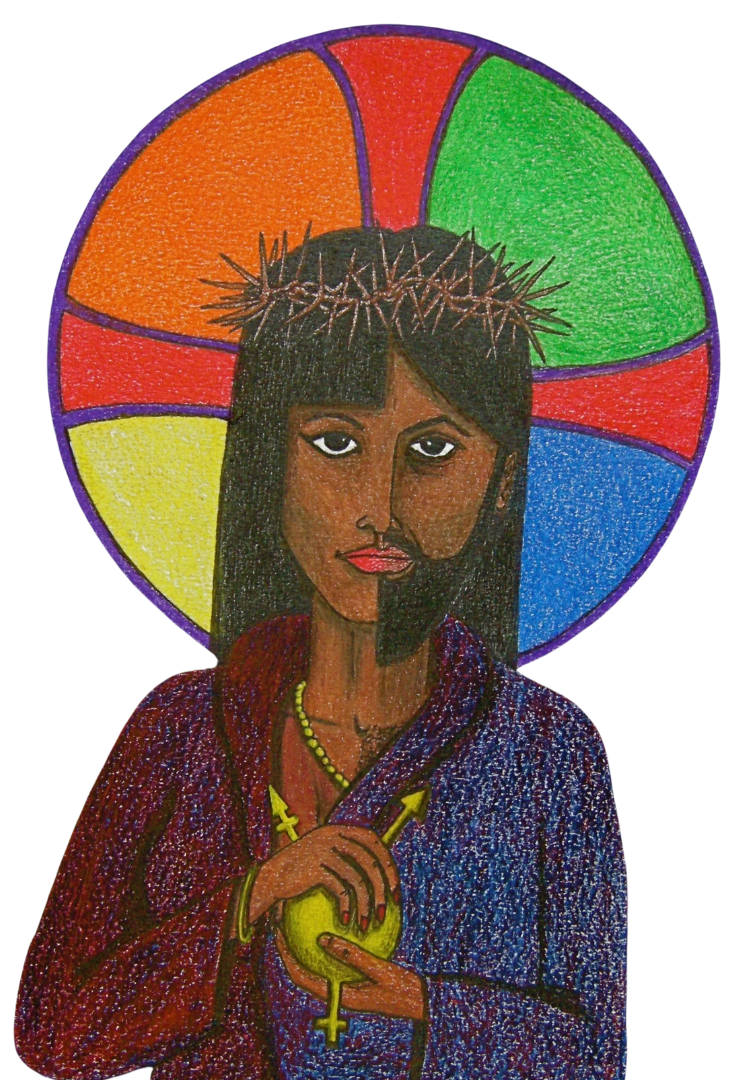
God, a genderless and genderfull being, folded Their infinity up into a tiny human infant and was subsequently assigned male at birth.
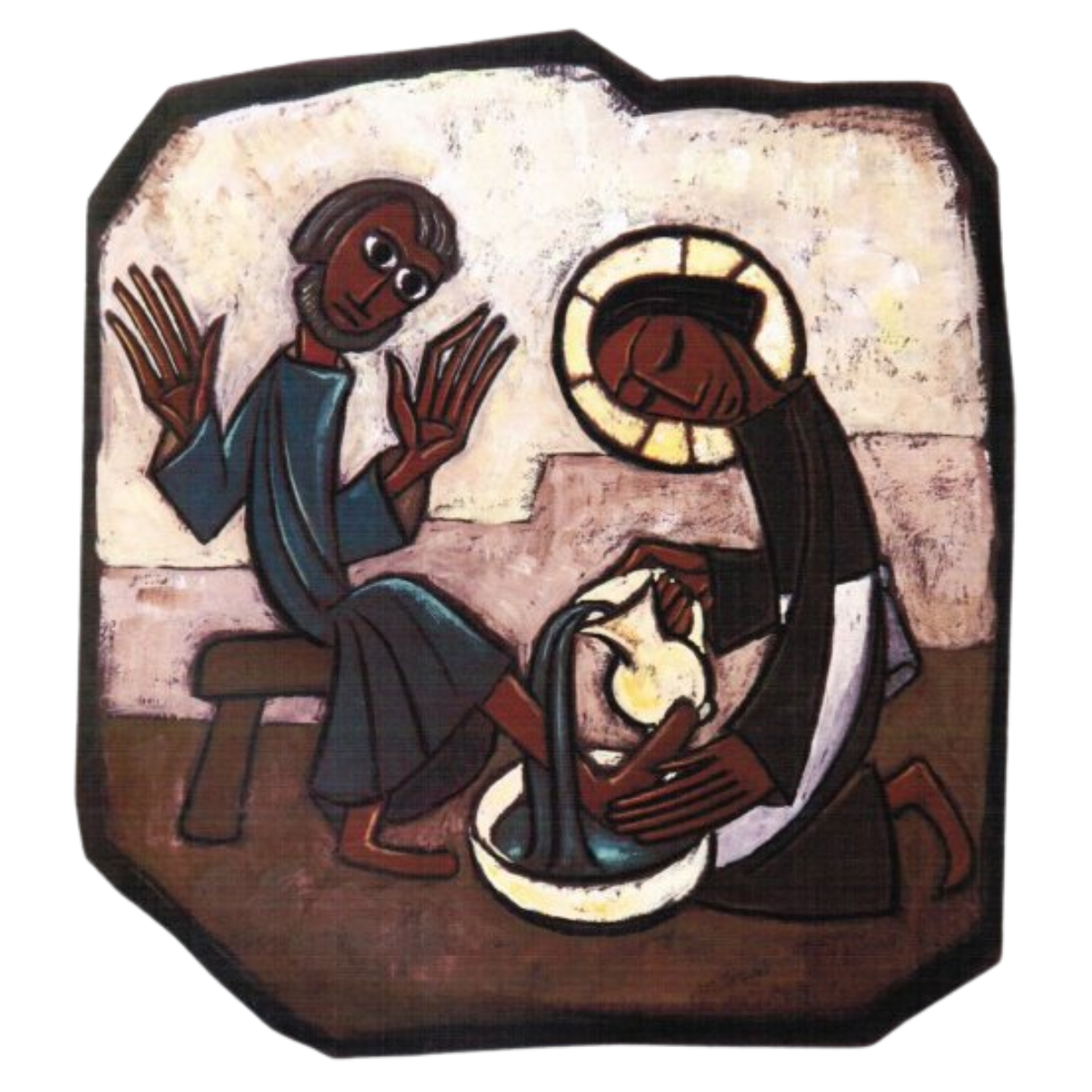
While Jesus is never recorded in the Gospels stating that he is not a man (though, sidebar, Godis recorded saying thus, in Hosea 11:9!), he does transgress many of the roles and rules expected of a man in his culture:
“Clearly, Jesus broke through barriers of gender many times during the course of his ministry. He spoke with women, he washed the feet of his disciples (an act usually performed by women or slaves), and he included women among his followers. …One of the controversies of Jesus’ life was his willingness to act in ways counter to societal convention in order to live out his spiritual truth. He defied gender norms in order to transform the lives of both women and men.”
“In not having a household Jesus did not behave like a ‘real man.’ He was ‘out of place.’ He rejected marriage (or at least the Bible does not mention him being married at all), and he abandoned his family name, power and status. He also called his disciples to abandon their households (Luke 9:59-62, 14:26), removing them from their normal gender roles in society.”
Tanis also records the comments of Michelle Dee on how Jesus’ experiences are similar to those of trans people today:
“We face harassment not only on the streets, but in our homes; Jesus talked about situations in which families were separate. Trans people…are very often unable to find meaningful employment in our fields; Jesus said that even he had no place to lay his head. Trans people are even killed because of who we are as Jesus was killed.”4
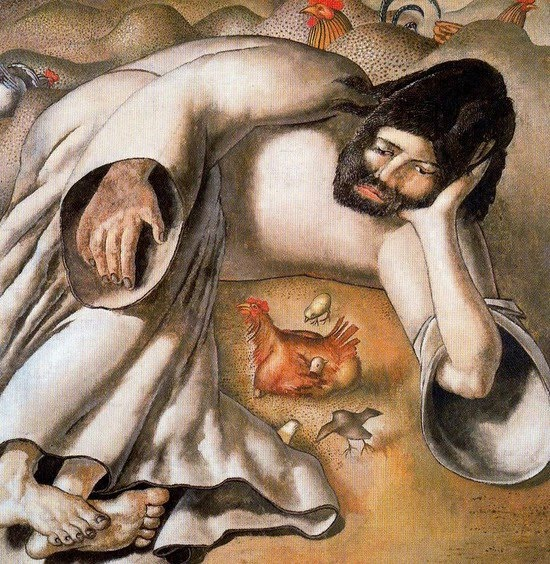
Jesus also made use of feminine language to describe himself several times throughout the Gospels, including in John 16:21-22 & 17:1, when he connects his “hour” of suffering on the cross with the “hour” of labor pangs; and in Matthew 23:37, when he compares himself to a mother hen. In his language and in his actions, Jesus was gender nonconforming.
I further discuss Jesus’ gender “transgressions,” and link them to his identity as perceived by himself and by others (“who do you say that I am?”) in a short sermon available as video and transcript here.
Early and Medieval Christians recognized the fluidity of Christ’s body and frequently depicted an androgynous Christ bearing both masculine and feminine characteristics, as will be explored on the next page of this timeline offer examples.
As stated before about Jesus and intersex persons, it is not necessary that Jesus himself be transgender in order for trans persons’ lives to have value. Even so, many intersex persons and trans persons may be encouraged to know that Jesus may have been like them — not only in sharing in their humanity, but in very particular and marginalized ways. As Tanis puts it, “Being able to identify with Jesus in the midst of suffering and hardship is one way that people through the centuries have found comfort and hope.”5
EUNUCHS FOR THE KINGDOM
Matthew 19
Jesus is known for offering his disciples some difficult-to-decipher wisdom throughout the Gospels; one such instance is in Matthew 19:11-12:
“Not everybody can accept this teaching, but only those who have received the ability to accept it. For there are eunuchs who were born that way from their mother’s womb. And there are eunuchs who have been made eunuchs by other people. And there are eunuchs who have made themselves eunuchs because of the kingdom of heaven. Those who can accept it should accept it.”
The first two types of eunuchs Jesus names would have been familiar to his audience: eunuchs made eunuchs by people are those who have been (forcibly) castrated, while born eunuchs are people who were assigned male at birth, but who do naturally not develop male-assigned sex characteristics at puberty — i.e. they are intersex!
However, there are no records of anyone before Jesus describing people who “have made themselves eunuchs,” for the kingdom of heaven or any other reason; he seems to have invented this category. Christians across the last two millennia have debated his meaning; a trans scholar named Victoria Kolakowski argues that Jesus was actually speaking about people like himself!
(Read more)
Kolakowski argues that in Jesus’s day, eunuch was likely used as a derogatory slur for men who failed, for whatever reason, to have offspring — what she calls “procreative deviants” in a world in which to be a man was to have children (sons) to carry on your legacy.6 I’m reminded of how gay is sometimes used today: e.g. “You’re __ years old and you’ve never had a girlfriend? What are you, gay??”
As discussed in the previous section, Jesus with his lack of wife and children, would have been one of these procreative deviants; we can imagine that he was mocked as a “eunuch” by some. What’s remarkable about his response, Kolakowski notes, is that Jesus does not hurry to correct people making that accusation (“Me, queer a eunuch?? No no, you’ve got it all wrong!”). Rather, in Matthew 19 Jesus embraces the term, naming himself alongside both castrated and intersex eunuchs:
“…Jesus took that derogatory slang word thrown at him and proudly claimed it as part of his own identity. This is exactly what modem activists have done with the word Queer. Jesus’ saying here was an ‘in-your-face’ comeback, and it was so shockingly powerful that his followers remembered it and later wrote it down. We need to proudly acknowledge this and inform our fundamentalist Christian detractors that Jesus was “Queer” in his society’s eyes and that he claimed us to be his family.”
Finally, Justin Tanis notes how this passage is yet another example of Jesus defying the norms of his culture; here, Jesus challenges the concepts of shame and honor, wherein the eunuch’s “imperfect” body is accepted by Jesus as whole.8 In our own day, trans bodies are placed under a microscope, with any and all changes we make to them judged and considered mutilation by some. Jesus accepted the bodies of eunuchs, whether they were thus “from birth” (as intersex people’s are), made thus “by others” (as too often occurs to intersex newborns and youth who are subjected to medically unnecessary surgeries), or made thus by themselves (as with trans persons who transition via surgeries and/or hormone therapy, or simply by changes in outward presentation).
A SIMPLE JAR OF WATER
Matthew 26:17-19
On Passover at noon, Jesus sends Peter and John into town on a strange errand. He promises them that they will find someone carrying a water jar who can bring them to a place to celebrate Passover.
So what’s so strange about this water-bearing figure? As Peter Toscano explains in his performance of this scene, collecting water at the well was women’s work. B. P. Morton agrees: “A man who is carrying a jar of water – in public – in ancient Jerusalem, is a man who either 1) doesn’t give a hot damn about local gender conventions, or 2) is actively doing their best to live publicly as a woman.”
Indeed, the Greek word for “man,” aner/andros, is not used in any of the Gospels to describe this figure! Masculine endings are used, yes, but for human beings masculine is the neutral option in Greek. Instead of aner, Luke 22 and Mark 14 use anthropos, “human;” and Matthew 26 uses the even more vague term deina, “a certain one” (which actually is a term using neuter endings).
Transchristians.org refers to this water carrier as one of our “trans-cestors,” a person who would likely identify as transgender in our culture. This person must already have some sort of relationship with Jesus before the Passover, as the disciples need only tell them that “the Teacher” needs a place to stay in order to get this person’s help.
What a beautiful figure, tucked in among the verses of three Gospels! We tend to overlook this key character, just as gender nonconforming persons are invisibilized in our own day. But Jesus knew this person. Even better, Jesus did not look at his relationship with the water carrier as one wherein Jesus did all the giving, and the water carrier was just lucky to count Jesus as a friend — no! Jesus knew he could count on this water bearer in his time of need to offer him and his disciples a place to celebrate passover. Trans persons have been seen and loved by Jesus, have had gifts to share with the Body of Christ, since the very beginning. And the relationships between cis and trans persons are reciprocal ones, supporting and being supported by one another.
A EUNUCH BAPTIZED: GOOD NEWS FOR MULTIPLY MARGINALIZED CHRISTIANS
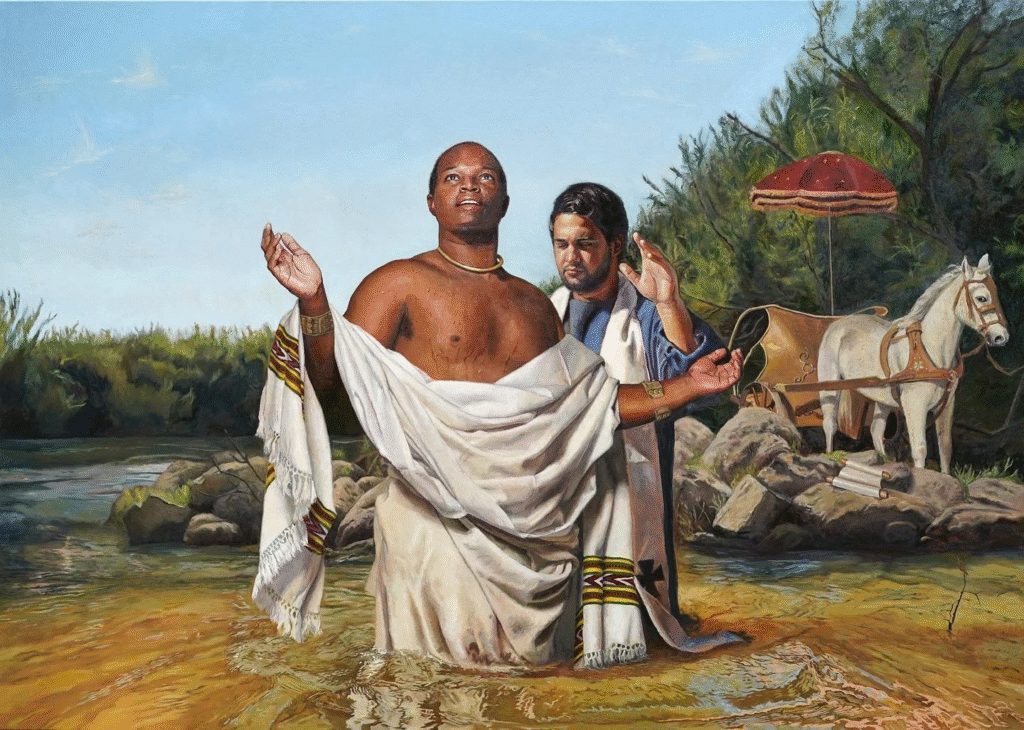
Another eunuch appears in Acts 8, after Jesus has already ascended into heaven and his apostles are doing their best to spread his message. On a desert road, Philip encounters a eunuch reading from Isaiah, who invites Philip to join him. After they explore the text together, Philip responds to the eunuch’s question “What is to prevent me from being baptized?” by baptizing him on the spot.
“As a transgender Latina, a person of color whose gender identity does not fit neatly into a binary, this passage tells me I can be baptized for I am a child of God.”
The eunuch was marginalized at least three times over: by class (enslaved), nationality (Ethiopian and therefore a foreigner in Jerusalem), and gender identity (eunuch). Regarding the latter, J. David Hester asserts that in the Roman Empire, where there was social and legal pressure for men to fit a certain masculine ideal, “eunuchs were the nightmare embodiment of men’s worst fears. Eunuchs were a monstrous identity formation, a source of sex-gender confusion.”9
(Read more)
Trans persons and others who cannot or will not conform to gender norms in our own day face similar ostracization; we too are regarded as “unnatural” by some and “monstrous” by those who see in us a threat to their own gender identities. But like the Ethiopian eunuch, nothing can stop us from being baptized! God welcomes us just as we are into the Body of Christ; through baptism, the male/female binary falls away.
Of course, baptism does not immediately solve all of this eunuch’s problems; he still lives in a world that shuns him for his class as a slave and his gender identity as a eunuch. Thus it is for trans persons today: forming a relationship with the divine or finding a faith community may transform us from the inside out, but we continue to face violence and stigma.
With the eunuch we rejoice that God does not see our gender identity as something that has to be “fixed” in order to join the Body of Christ; but with the eunuch we also have to keep waiting for that coming Kin(g)dom wherein God’s justice and grace will liberate us from oppression once and for all.
REWIND 500 YEARS: A TRANS PROPHET
Altar in Athens dedicated “to an unknown God,” such as the one Paul describes in Acts 17 before quoting Epimenides.
Acts 17:28 and Titus 1:12
In his letters, Paul makes use of various classical authors to make his points. One such author is Epimenides, whom Paul quotes in Acts 17:28 and in Titus 1:12. (You know the famous “In him we live, and move, and have our being” verse? That’s Paul quoting Epimenides!)
In Transgender Journeys, Virginia Mollenkott describes her discovery of Epimenides and the wonder it brought her. I quote a large passage of it here, as it is such a powerful testimony to what it can mean to find oneself in scripture:
(Read more)
“When I was young, it would have given me enormous courage had I known that not just once but twice the New Testament honors a transgender and homoerotic prophet by quoting him in a positive context. …I am referring to Epimenides, a poet and prophet who lived in Knossos, Crete, in the sixth century B.C.E.
…According to Greek sources, Epimenides was the shaman who successfully helped to rid Athens of a plague and who assisted the Athenian statesman Solon in his famous reforms, including the institutionalization of homoerotic love as it was practiced in Crete. In his book Greek Divination (1913), William R. Holiday compares Epimenides to the transgender shaman Tiresias, who changed sex several times and whose clothing was simultaneously ‘masculine’ and ‘feminine.’ Knowing all this, and knowing his learned audience would know all this, the apostle Paul twice quotes Epimenides to buttress his own argument. In fact, in the epistle to Titus, Paul goes so far as to call Epimenides a prophet!
I was told all my life that the Hebrew and Christian Scriptures are unanimously negative about gay, lesbian, and bisexual experience, and I was profoundly shamed because of my transgender characteristics. How stunned, and then how liberated I would have felt to be told that one of my kind had been featured favorably in the canon of sacred Scripture! …That knowledge alone would have been enough of a ray of hope to prevent my suicide attempt.”10
It is my fervent prayer that trans and questioning persons like Mollenkott will have access to pieces of history like this one — knowledge of our “trans-cestors” that remind us that we are not alone, that we have always existed, and that God made us with purpose.
Jennifer Ann Cox, Intersex in Christ: Ambiguous Biology and the Gospel (Cascade Books, 2018), p. 99 ↩︎
Justin Sabia-Tanis, Trans-Gender: Theology, Ministry, and Communities of Faith (first published by Pilgrim Press in 2003, reprinted by Wipf and Stock in 2018), pp. 138-139 ↩︎
Victoria Kolakowski, “The Concubine and the Eunuch: Queering up the Breeder’s Bible,” chapter 3 in Our Families, Our Values: Snapshots of Queer Kinship, editors Robert E. Goss and Amy Adams Squire Strongheart (New York: Harrington Park Press, 1997), pp. 35-49 ↩︎