
100 – 1399: Mystics, Monks, and Plagues
The centuries spanning from 100 to 1399 CE bore witness to major transformations in Christianity. The early churches go from enduring periodic bouts of persecution to enjoying legitimization in 313, when Constantine declares Christianity a legal religion in the Roman Empire; in 380, the Emperor Theodosius will go one step further by making Christianity Rome’s official state religion.
Mystics, monks, and nuns roam across the land or settle down into monasteries, many of which will become havens for persons assigned female at birth who wish to avoid the marriage and motherhood expected of them, as well as persons assigned male at birth who break gender norms.
Even so, Christianized feudal Europe became more and more dangerous for gender variant people, along with all others whose existence challenged the patriarchies that were replacing ancient matrilineal societies.1 Even while raising up some gender nonconforming figures as pious models for Christians to follow, the Church was establishing a campaign against trans people that would rage through the coming centuries.
We cannot know which modern terms for sexuality and gender these persons would identify with today. Nevertheless, their words and experiences resonate in one way or another with Christians today who are trans, nonbinary, or otherwise gender diverse.
- SAINTS TRANSCEND GENDER…
- …AND GOD TRANSCENDS GENDER
- MANLY WOMEN…
- …AND BEARDED WOMEN
- TRANSMASC MONKS
- GENDERFLUID CAPES
- ST. BERNARD, BRIDE OF CHRIST
- MOTHER FRANCIS AND THE ALL-FEMALE TRINITY
- WELCOMING BROTHER JACOBA AND CLARE OF ASSISI
- THE ANDROGYNOUS CHRIST
- A BABY BOY AND AN ALLEGED FEMALE POPE
- THE GENDERING OF HAIR
- GENDER TRANSGRESSORS: SACRED OR SCAPEGOAT?
SAINTS TRANSCEND GENDER…
[Section coming soon.]
…AND GOD TRANSCENDS GENDER
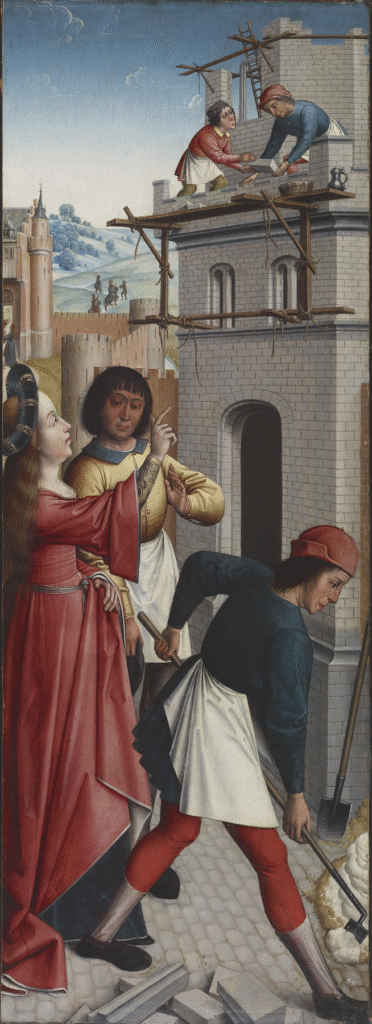
Saint Barbara very much identified with the idea that Saints were beyond human categories of male and female — and she proclaims that God is, too.
When her father Dioscorus, a pagan king who persecuted Christians, orders the construction of a tower to confine his lovely daughter, Barbara instructs the workers to alter the blueprints to feature not two but three windows. When Dioscorus asks her why, she replies:
“…[B]ecause three windows enlighten all humankind but two engender darkness. Humankind is born divided into only two sexes, that is, man and woman. Therefore, as far as we are concerned, two windows suffice, but in the threefold number of these windows, father, a greater mystery is hidden. Please be patient and hear me out. These are the Father, the Son and the Holy Ghost, who are not three gods but one true God, the Creator of all.”2
To Barbara, closeness to God involves a rejection of simplistic human concepts like sex/gender in favor of the complexity of wondrous mysteries, divine wisdom impossible for human minds to fully grasp.
(Read More)
It’s important to note that Barbara’s statement is not an attempt to gender God as, say, tri-gender; rather, she connects sex/gender to the Trinity in order to compare the limits of human categorization versus the infinite possibilities of Divinity. In other words, “The main characteristic of God is that He [sic] is different from everything in creation. …God was not to be encapsulated in the concepts that humankind could invent.”3 To Barbara, God is beyond sex/gender — and, therefore, Christians should strive to be too.
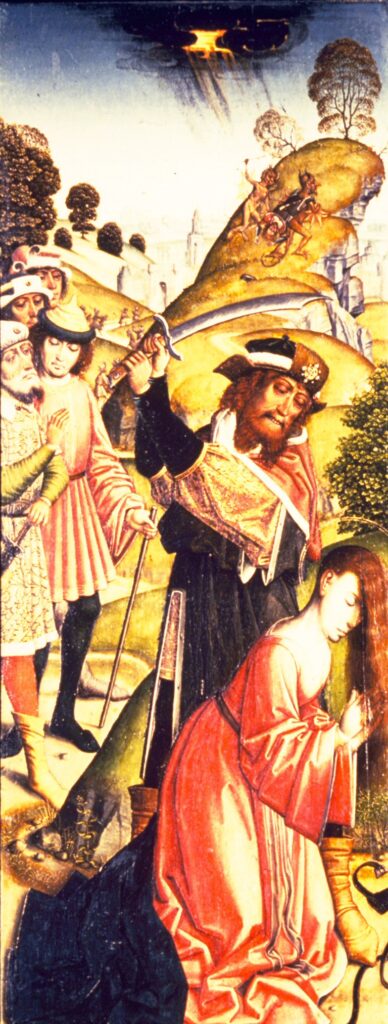
After Barbara comes out as Christian through her declaration of the Trinity, Barbara’s father is enraged. He threatens her, drags her before the local judge, even tortures her — yet Barbara refuses to recant her faith and vow of virginity. Finally Dioscorus has enough, and beheads his daughter on a mountaintop — and is struck by lightning in divine retribution.
Mathilde van Dijk digs deeper into the ways that Barbara’s holy desire to illuminate the path to God’s love contrasts with her father’s cruel “love”:
“St Barbara’s father…uncharitably strives to hide a beautiful part of creation [Barbara] from his fellow human beings, rather than sharing it. His rages and eventual execution of his daughter show that his love lacks measure. Saints offer an alternative by the measured love of their charity,” through which they aim to guide others towards God.4 Moreover, van Dijk continues,
“[W]hilst earthly parents may not always be able to accept trans saints on their own terms, God’s love embraces trans saints entirely, not in spite of their transness but perhaps because of it.”
MANLY WOMEN…
Brother Robert Lentz
While many early Christians conceived of Saints as beyond gender, others connected Saints assigned female at birth — particularly those who were martyred — with manliness. These concepts of either transcending gender or becoming more masculine are not as opposed as they may seem: In many ways, masculinity was viewed as the default way to be (as it is today; hence why, for instance, it’s commonplace to call a group of multiple genders or even all women “guys,” but unheard of, even offensive, to address a group of men as “girls”).
While we should recognize misogyny in the conflation of masculinity and neutrality, as well as in apparent need to associate courage and strength with manhood, these Saints nevertheless fall into the “gender variance” with which this site is interested.
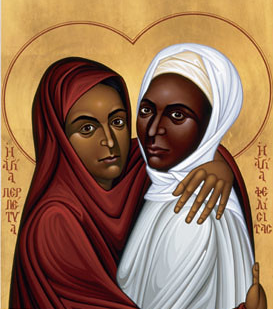
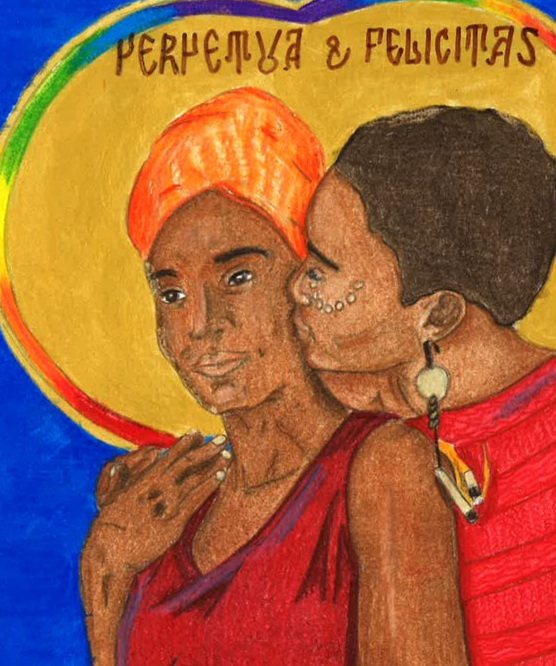
Among these Saints, none are more beloved than Perpetua and Felicity (or Felicitas), two North African martyrs whom Early Christians heralded as “neither male nor female” due to the “manliness of their souls.”5
(Read More)
by Keats Miles-Wallace
Cultural Context: Early Christians’ Non-binary Status
Felicity and Perpetua both belonged to Carthage’s Christian community. Before 250 CE, the Roman Empire largely left Christians alone: “Emperors tend not to care much about what people are doing as long as the servants and horses are not disturbed, taxes are collected, and nobody starts a rebellion.”6 So long as they remained small and inconspicuous, these early Christ-communities weren’t worth the effort, despite their tendency to disrupt gender and class hierarchies.
However, tension did sometimes arise on local levels due to the ambiguous space Christians occupied in the Jew/Gentile binary: Christian gentiles were indeed gentiles, but claimed “the legal prerogative of Jews,” who had an established agreement with Rome that they would not be compelled to partake in pagan religion. Gentiles were not afforded this exemption, and by law had to honor various gods. By refusing to participate in “the civic cult” that was integral to the fabric of Roman society, “certain Christians made themselves conspicuous and invited upon themselves legal action on the part of governors” — which is exactly what happens in the case of Felicity and Perpetua.
They bonded in a Carthage prison as they and several men awaited execution, c. 203 CE. shared faith and fate cut through their class difference — Perpetua was a young, well-educated noble, while Felicity was an enslaved woman — and they drew comfort from each other while awaiting their sentence.
Familial Pushback and Found Family
In the diary Perpetua kept while in a Carthage prison (the earliest Christian document confirmed to have been written by a woman!), she describes her father’s reaction to her insistence on proclaiming her faith even unto death. He visits her in prison to beg her to think of her family — not just of him and her mother, but even her own baby, who is in prison with her so that she can keep nursing him.
“Give up your pride!” Perpetua’s father insists. “You will destroy all of us!” But Perpetua stands firm; she will not conceal what she is: “I cannot be called anything other than what I am, a Christian.” Such a declaration is resonant for many trans persons, who insist on being called what we are in regards to our names and genders.
Queer people also know what it is to be guilted and blamed for pain caused not by us, but by others’ reactions to our expressed truth. While Perpetua grieves the break with her father and family, she refuses to renounce her faith. She lives into Jesus’s admonition that “Whoever comes to me and doesn’t hate father and mother, spouse and children, and brothers and sisters—yes, even one’s own life—cannot be my disciple” (Luke 14:26). This rejection of familial ties, and especially of motherhood — she ends up giving her baby over to her father after difficulty nursing him in prison — is counter to every value she was meant to uphold as a woman and Roman citizen. Yet despite what the world says, Perpetua is joyful in her decision.
When we choose to live into our calling, we may lose family; but what we gain is precious indeed. Perpetua, for instance, experiences the beauty of found family in her fellow martyrs: “There’s an intense sense of community that binds together these people who are insisting on being martyred. They take care of each other.”7
The love between Perpetua, Felicity, and their male comrades was so deep that as the date of their execution drew near, they all grew distressed — not because of their impending deaths, but because Felicity would not be able to go with them due to being eight months pregnant; she would be executed at a later time, alone. So they all prayed to God “in one torrent of common grief,” and Felicity went into early labor. Her newborn is given to a sister Christian to raise as her own; Carthage’s entire Christian community is one chosen family, with ties stronger than biology or class.
Donning Masculinity
At last we get to the ways that Perpetua’s diary (including the account of the actual execution added on by an editor) associates masculinity with these two women.
While still in prison, Perpetua records a vision in which she is brought into the Roman arena to face not beasts, but a huge, burly human fighter. As she is made ready for the fight, she finds herself transformed: “My clothes were stripped off, and suddenly I was a man.” In a scene rife with homoerotic overtones, Perpetua-the-man is rubbed down with oil by two handsome young men, then engages in hand-to-hand combat with the enormous opponent — and triumphs over him using miraculous agility.
For Felicity, meanwhile, the “feminine” labor of childbirth and motherhood is connected to the “masculine” labor of a gladiator: “glad that she had safely given birth so that now she could fight the beasts” with her companions, Felicity is described as transitioning “from one blood bath to another, from the midwife to the gladiator, ready to wash after childbirth in a second baptism.”
This couple is also rightly beloved among sapphic Christians today; see their article on Qspirit.
…AND BEARDED WOMEN

Various accounts of persons assigned female at birth miraculously growing beards exist from this time period. Intersex women (cis or trans), trans women, trans men, and nonbinary persons of our own day who choose to have beards may identify with these figures: Though their beards were called “monstrous” and “unnatural” and considered to be “blemishes” or even marks of “disfigurement” by the Saints’ enemies, the Saints themselves gave thanks for their facial hair, understanding their beards as a blessing from God.8
The bearded Saint with the greatest following is Wilgefortis, whose legend places her in medieval Portugal and “disrupt[s] the binaries of male and female, and the human and the divine.”9 Queer Catholic R/B Mertz sums up this holy figure’s upending of the status quo and message to gender nonconforming persons thus:
“In Wilgefortis’s story, the father was the villain and the bearded lady was the saint.”10
(Read more)
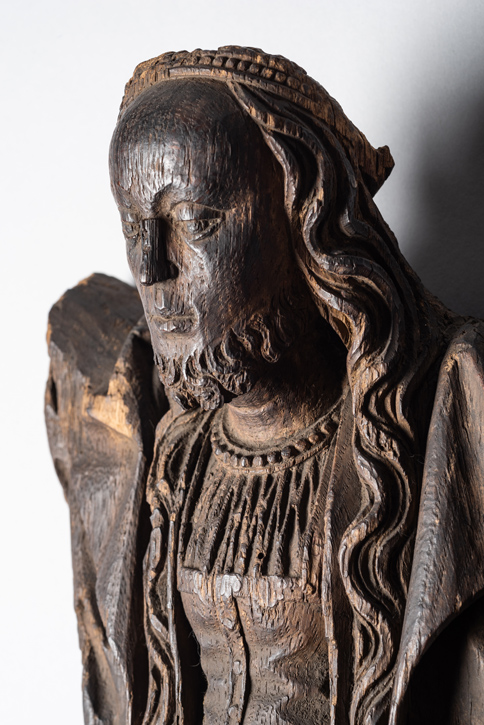
Wilgefortis’ name most likely means “strong/courageous virgin” and indeed, she refused to marry even unto death. When her father arranged a marriage with a pagan king, Wilgefortis prayed to Jesus for help; she then grew a beard that caused her suitor to leave her at the altar. Furious, her father had her crucified.
R/B Mertz speaks to the power of this Saint in their 2022 memoir Burning Butch. Mertz grew up inundated by religious messages that queerness is abominable in the sight of God, leaving them a mess of guilt and self loathing for a long time. When as an adult they discovered the story of Wilgefortis, they recognized their own story of abuse: “When [Wilgefortis’s] father found out what had happened, he had his daughter crucified. Maybe I believed I was bad because my father tried to crucify me. Like […with] Abraham and Isaac: How was that supposed to make me feel? And why had it taken me so long to even think about feeling it?”11
Mertz also ponders whether their path to embracing their queerness as sacred would have been smoother if they had learned of Saints like Wilgefortis sooner:
“Things might’ve been different if I had heard about Wilgefortis, if I had heard more about Joan [of Arc], and less about what the homeschoolers thought about birth control, less about what my dad thought about gay people… Stories were important, and I was just beginning to hear the right ones.”
These stories matter; evidence that Christianity and queerness have always been intertwined matters to real people in real, tangible ways. …Even when some of these stories turn out to be “just” stories, the historicity of the Saint debunked, as is the case with Wilgefortis.12
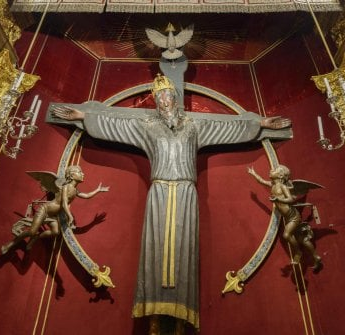
If Wilgefortis was never a real person, where did this legend of a bearded woman crucified come from? One possibility is that a popular image of the crucified Christ — perhaps the Volto Santo, or Holy Face of Lucca, Italy — was mistaken for a woman due to it depicting Christ in robes instead of a loincloth:
“The carving of Jesus Christ is the oldest known wooden sculpture in Europe, radiocarbon dated to [770–880 CE], but lots of other later copies exist. It’s thought that the long robe worn by the Holy Face caused people in the Low Countries to see a (bearded) figure in a dress. The name Wilgefortis could even be a corruption of ‘Hilge Vartz’, or ‘holy face.'”13
Imagine that! — the earliest European wooden sculpture is of a Jesus androgynous enough to birth the legend of a woman blessed by a beard.
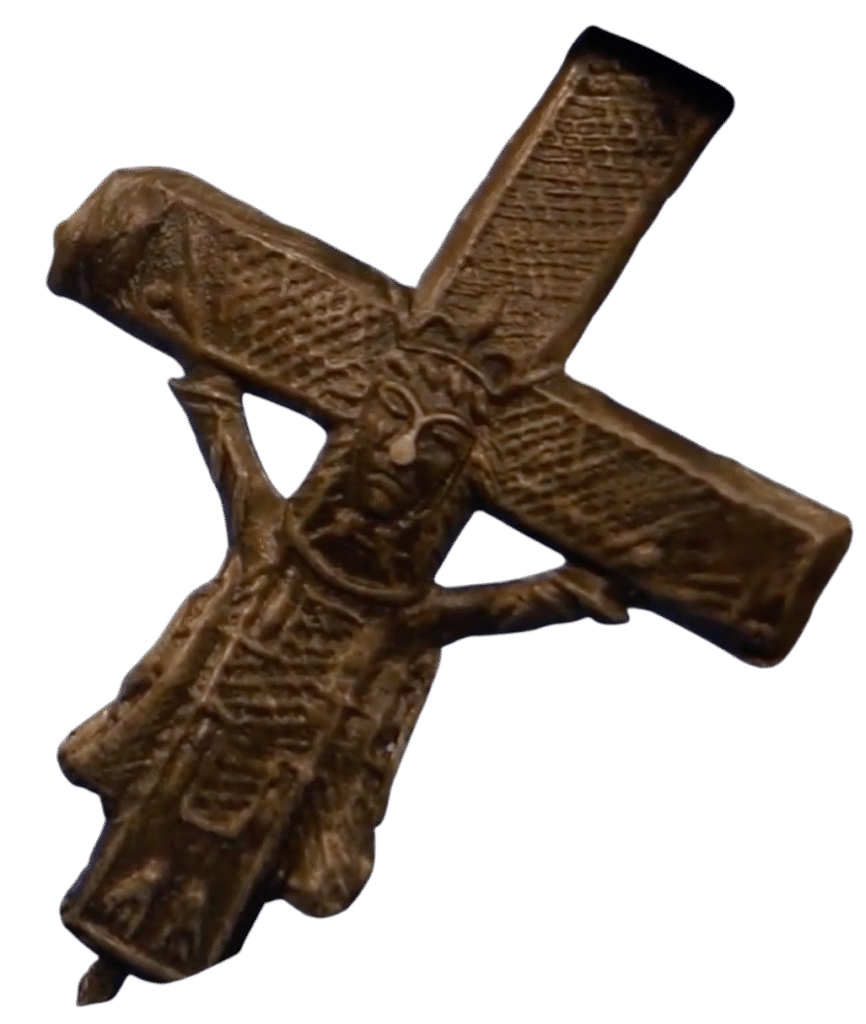
What is more, this case of mistaken identity goes in both directions; just as some medieval Christians mistook images of Jesus for a woman, curators occasionally mistake images of Jesus for Wilgefortis (as with the medieval pilgrim’s badge pictured to the right). In this way, Jesus and Wilgefortis build off of and enhance one another’s gender fluidity.
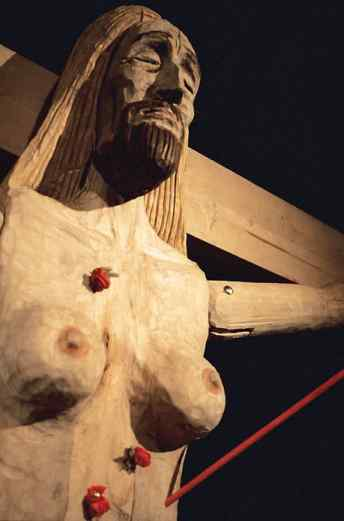
Across the centuries, Wilgefortis has been a comfort and help to women in unhappy or abusive situations, or who simply do not want to get married. In some Latin American countries she is particularly popular under the name of Santa Librada (“liberated”).
Other variations of Wilgefortis over the centuries include Saint Uncumber (“disencumbered,” England) and Saint Ontkommer or Kümmernis (ohne Kummer, “without anxiety,” Netherlands).15 For more on Wilgefortis, see QSpirit’s article.
Wilgefortis is not the only bearded female Saint. St. Paula Barbada also grew a beard after praying to Jesus for protection, this time from a man attempting to assault her; some sources claim her genitalia were also transformed.
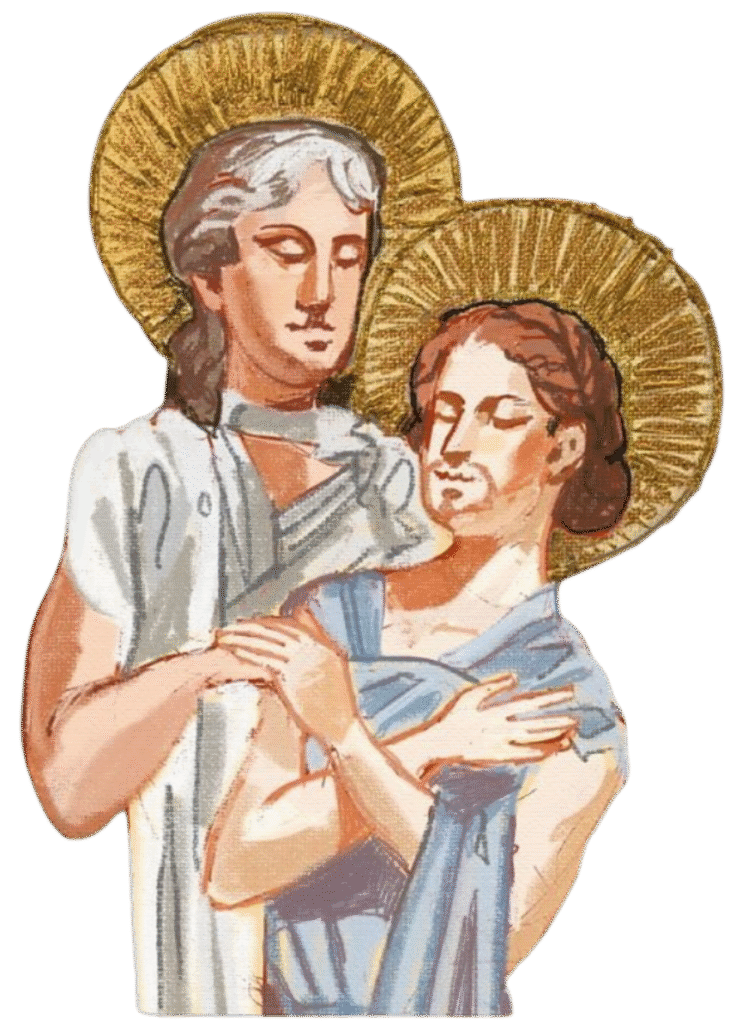
Meanwhile, a Roman noble from the 500s CE named St. Galla wished to become a hermit after her husband’s death; in her solitude, she grew a beard.16 In my imagination, Galla is firmly intersex: She always had the ability to grow a beard, but shaved it to keep up with gendered expectations until freed from the need to conform for her husband (plus, shaving implements aren’t exactly readily available for a hermit). Galla is also a paired Saint with Benedicta; read about them here.
Finally, St. Catherine of Siena (1347-1380) was an Italian nun who experienced visions from the age of 6 onward and was known for her healing power. Some doubted these experiences, including St. Raymund of Capua — until “Raymund saw a vision of Catherine’s face transforming into that of a bearded man. Catherine, Raymund believed, had achieved a mystical union with Christ, as a result of which she had become mystically transgendered.”17
TRANSMASC MONKS

Along with sprouting beards, a good number of persons assigned female at birth (afab) donned monks’ robes. Some of these Christians did so in order to hide from pursuers. Others chose to become monks (rather than nuns) for reasons that remain obscured; I believe that at least some of them would have identified as transgender in our own time…
For instance, there is Saint Marius (who lived either in the 400s or 700s), who was evicted from their monastery when a woman accused them of fathering her child. In exile, Marius raised this child without ever disclosing their assigned gender; only after death did anyone discover Marius’ secret.18
(Read More)
Saint Eugene/ia of Alexandria (183-258CE) faced a similar situation to Marius: Entering a monastery after converting to Christianity with her two eunuchs, Protus and Hyacinth, Eugene’s gender identity remained a secret until a woman tried to seduce them and, failing, accused Eugene of making sexual advances towards her. Rather than choosing exile over disclosing their assigned gender as Marius did, Eugene revealed themself to clear their own name.19
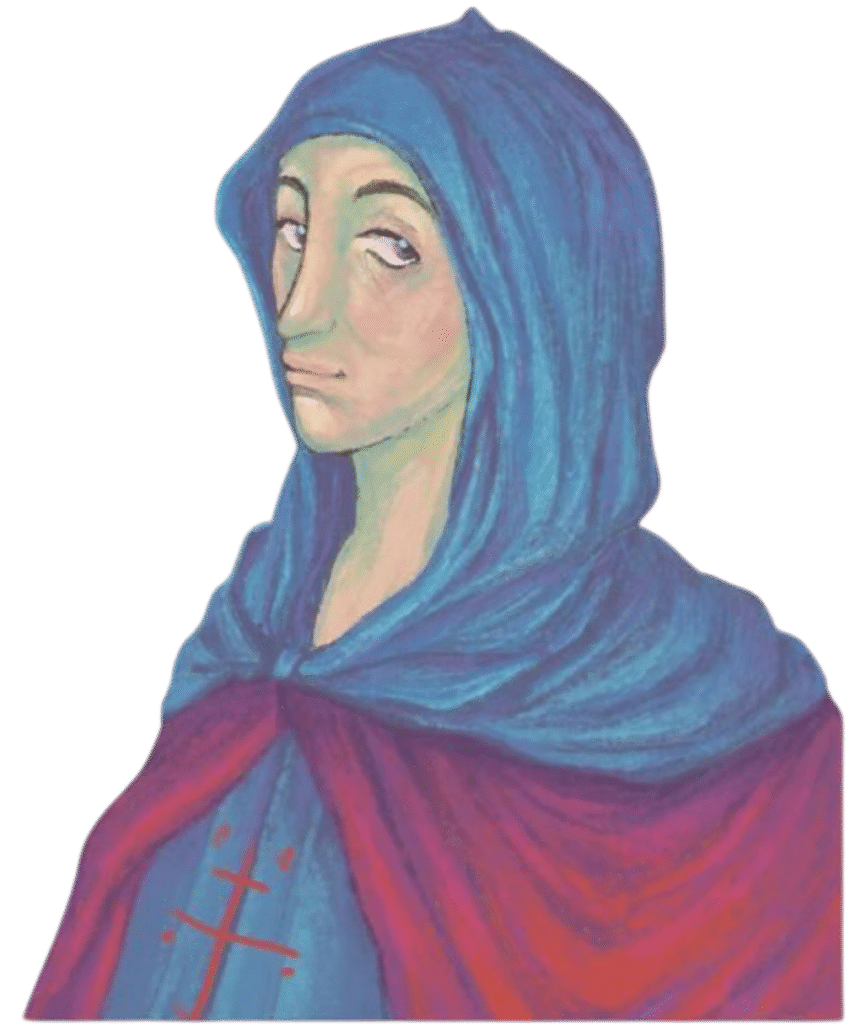
by Snow Initiative
Yet another story following the trope of “Monk accused of making sexual advances must reveal themselves” is that of Dorotheus. On a pilgrimage to Jerusalem, Apollinaris Syncletica freed all but two of the slaves their parents had sent them with and then escaped those last two companions to join desert recluses in Egypt, taking on the name Dorotheus and passing as a man.20
Years later, Dorotheus’s sick sister was taken to the healer Macarius, who happened to be the head of those monastic recluses. Macarius instructed “Father Dorotheus” to perform the healing; they did so without revealing their identity. After the sister was sent home, she grew sick again and was presumed pregnant. She accused Dorotheus of seducing her, at which point Dorotheus revealed their identity to their family.
After a few days back home, Dorotheus returned to the desert to live out the rest of their life; their fellow monks only discovered their secret when preparing their body for burial.21
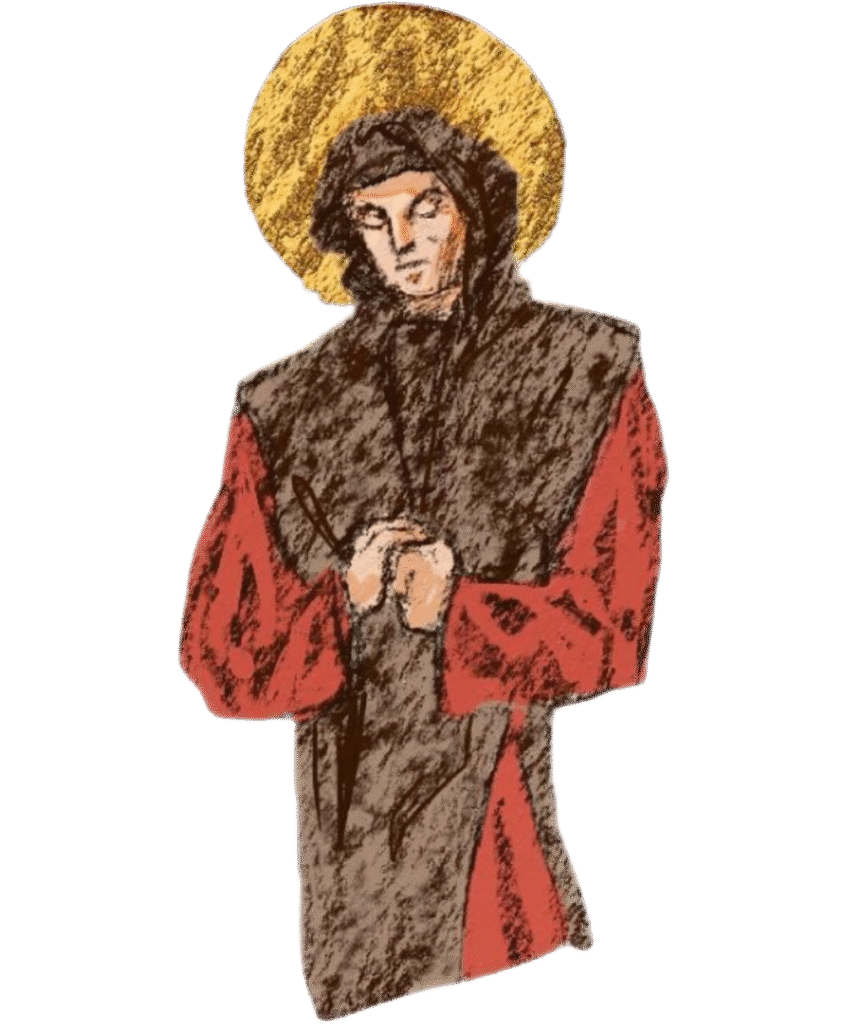
by Snow Initiative
Meanwhile, Pelagius (also called Marinos) is the name taken on by another convert to Christianity in the 300s. They left their life as “beautiful dancer and courtesan of Antioch” to become “wise brother Pelagius, monk and eunuch” in Jerusalem. Like Marius and Dorotheus, it was only after this revered monk’s death that their fellows discovered the secret of their anatomy. Pelagius’ mourners were said to chant,
“Glory be to thee, Lord Jesus, for thou hast many hidden treasures on earth, female as well as male.”22
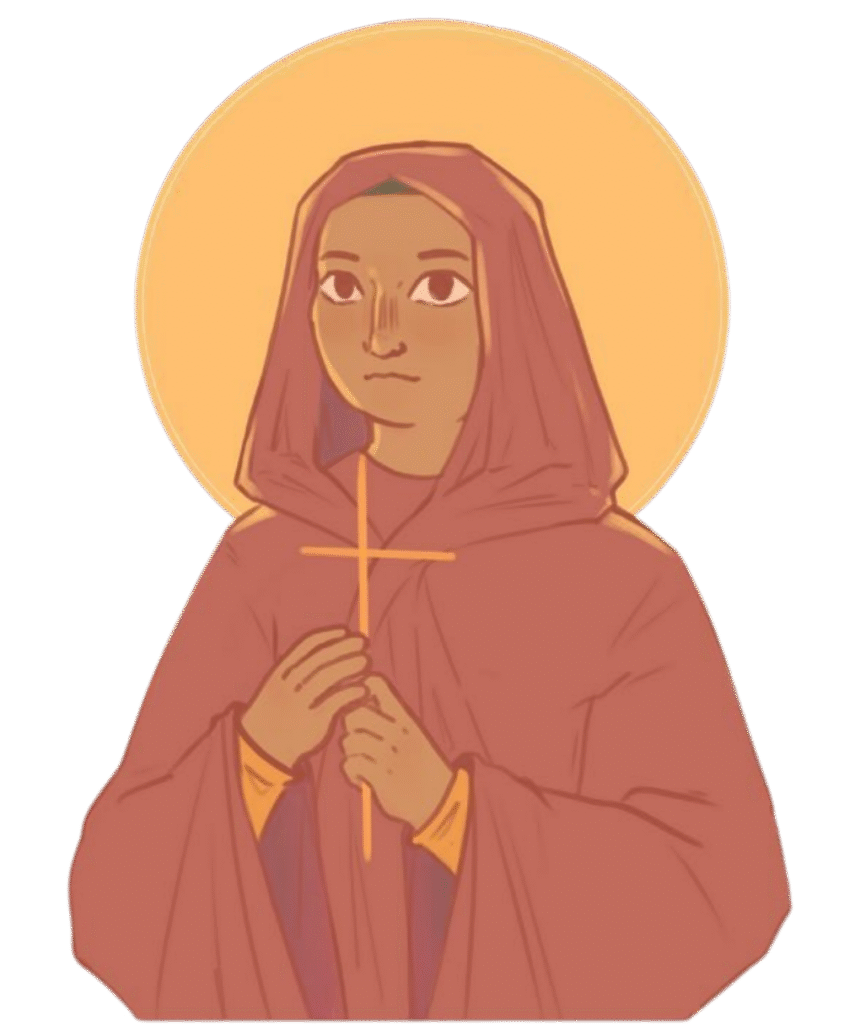
Smaragdus
by Snow Initiative
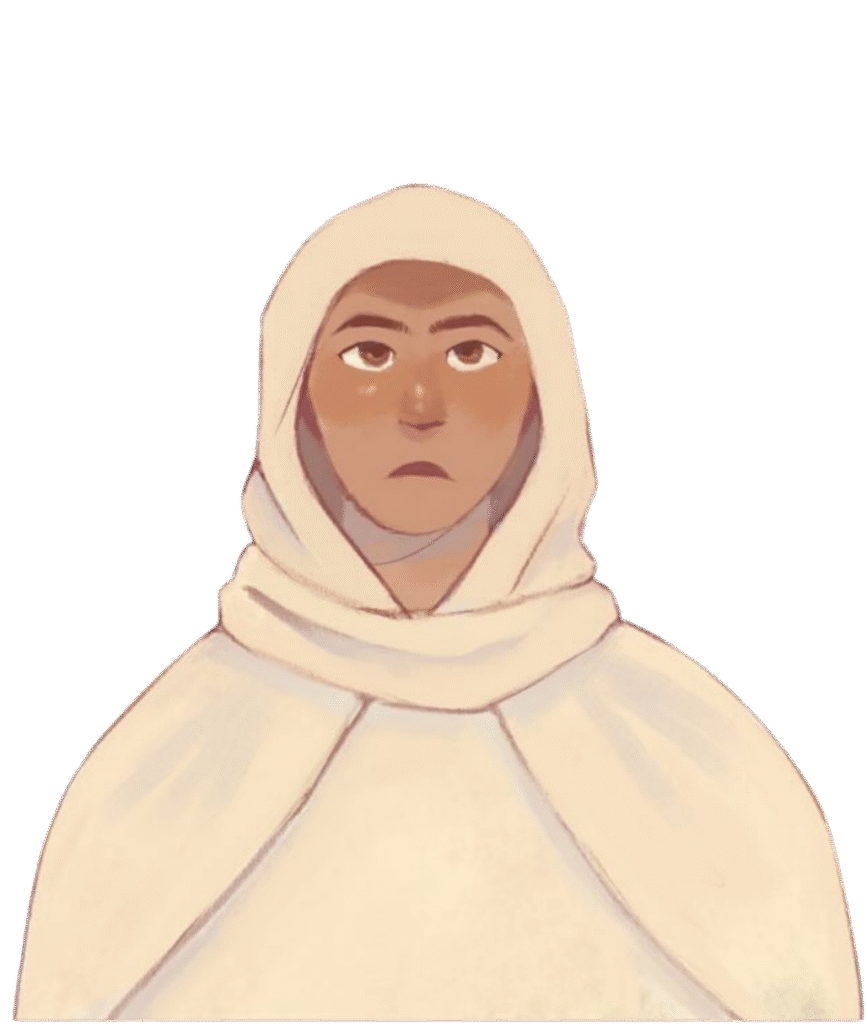
by Snow Initiative
Other AFAB persons who became monks, all purporting to be eunuchs, include Saint Euphrosyne/Smaragdus (400s CE), who fled their father to spend the last 38 years of their life as an acetic monk; Saint Matrona of Perge, who temporarily lived as the eunuch Bablyos to hide from her possessive husband (500s CE); and Saint Anastasius/a the Patrician (500s CE), who likewise was disguised as a eunuch to avoid the courtship of the Emperor Justinian. And only God knows how many more there were who were never “discovered” or outed!
GENDERFLUID CAPES
Monasteries proved to be havens for many gender variant persons assigned female at birth, but what about persons assigned male at birth?
The Carmina Burana is a collection of over two hundred Latin and German songs, many of which are irreverent parodies of religious songs and services. These songs hail from the 1000s through the 1200s, when they were gathered by a Benedictine monastery in Munich, Germany. At least two of the songs included in this collection “concern gender metamorphosis”: De vestium transformatione and Nullus ita parcus est.
(Read More)
Both songs “describe how, by way of the monks’ refusal to throw away worn-out fabrics, garments once worn by nuns or simply considered feminine are transformed into masculine garments. For instance, a cape, perceived then as a feminine item of clothing, is transformed into a mantle, a masculine garment. The lyrics suggest that the old garments or pieces of fabric carry magical powers that effect a kind of gender transformation in the monks. L. Barkan (1986) translates the first lyric as follows:
“So in the style of Proteus clothing is transformed… As the princes of the church change their sex in outward appearance, so secretly they patch up torn garments. …God makes a cape out of a mantle, and therefore it can be guilty of both sides of love”23
Perhaps this irreverent lyric hinted at the truth of gender variance among monks, who could sometimes express passionate love for one another and get away with feminine descriptors for each other, as the following accounts explore.

ST. BERNARD, BRIDE OF CHRIST

Saint Bernard of Clairvaux (c. 1090-1153) was a French abbot who had two great loves: an Irish archbishop named Malachy of Armagh and Jesus Christ.
Frequently referring to Jesus as his husband in his writing, Bernard is numbered among the Saints who envisioned themselves in a “mystical marriage” to Christ, which also includes Saints Bernardo de Hoyos, John of the Cross, and John of Verna.
One line of Bernard’s erotically charged poetry about Jesus reads, “I do not want your blessing, it is you I want.” What is more, many of his poems borrow the passionate imagery of the biblical Song of Solomon. Bernard identifies himself with the female character of Song of Solomon, the Shulamite; and he “abandons himself in soul to the spiritual caresses of the divine lover.”24
[Read More]
Another way in which Bernard applied femininity to himself, to Christ, and other “male figures” is in his use of maternal imagery, which Caroline Walker Bynum claims “is more extensive and complex than that of any other twelfth-century figure.”25 Bernard frequently described Jesus, Moses, Peter, Paul, prelates and abbots (i.e. certain religious leaders), and himself as mothers, often with lactating breasts: “Breasts, to Bernard, are a symbol of the pouring out” of wisdom or deep emotions upon others.26
Through the centuries after his death, the belief that “passing under the rainbow of Saint Bernard” could cause one to “change sex” spread from France all the way to Eastern Europe. In Romania, the legend went that a rainbow stands “with each end in a river, and anyone creeping into its end on hands and knees and drinking the water it touches will instantly change sex.”27 To me, this widespread legend shows that there were people back then who wanted to “change sex” — I love to imagine such a person seeking out the end of a rainbow in order to become the gender they wanted to be. For more on St. Bernard and his lover Malachy, see this article on QSpirit.
MOTHER FRANCIS AND THE ALL-FEMALE TRINITY

Francis of Assisi (1181-1226) is one of the most beloved of Catholic Saints, but many do not know about his and his monastery’s queerness.
Francis had his friars refer to him and to one another as “Mother.”14 He also claimed the title of “Lady Poverty” for himself after it was given to him by the Holy Trinity Themselves, as recounted by Francis’ contemporary Thomas of Celano:
“Three poor women appeared by the road as Saint Francis was passing. They were so similar in stature, age, and face that you would think they were a three-part piece of matter, modeled by one form. As Saint Francis approached, they reverently bowed their heads, and hailed him with a new greeting, saying: ‘Welcome, Lady Poverty!'”
(Read More)
While historians have traditionally assumed that these three women represented Poverty, Chastity, and Obedience, Franciscan Kevin Elphick compellingly argues that the language used for them, in emphasizing their uniformity of substance, proves that they are meant to be the Trinity. Elphick explains how a later writer, St. Bonaventure, had to engage in “confusing, metaphorical gymnastics” in order to avoid acknowledging a female Trinity.28 For what patriarch wants to imagine his God could ever be female?
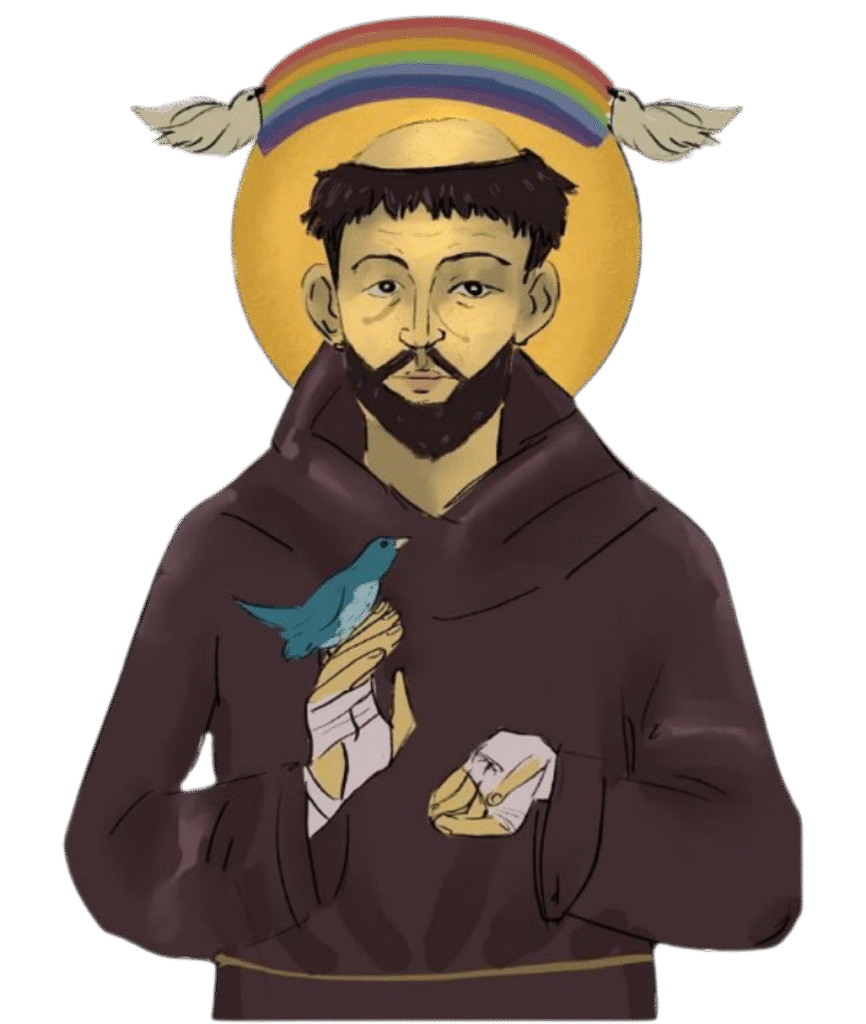
In the form of these three women, the Triune God recognizes and affirms Francis’ gender variance. They do not rebuke Francis’ use of feminine language but rather encourage it by gifting him with yet another feminine title. And They do so while appearing as female in all Three Persons! Perhaps by appearing thus, God hopes to suggest to Francis, “Your fluidity is beautiful. I too hold femininity and masculinity within Me — and everything beyond and in between.” How powerful for those of us who worry that God might frown upon us taking on a new name! We can see that God not only approved of Mother Francis but assisted him in his nonconformity.
The name “Lady Poverty” truly gets to the heart of who Francis is: one who revels in femininity because his society calls it “weak” and God calls the “weak” strong (1 Cor 1); and one who chooses poverty over wealth because in doing so he joins the most vulnerable in his world, including Christ Herself. As Kittredge Cherry puts it, “The genderbending name honors his commitment to upend social hierarchies and embrace poverty as a spiritual path.”
Trans and nonbinary persons do the same thing when we live into our true genders: we transition from cisgender privileges into the vulnerability of being trans. While this movement is derided by our society as foolishness — who would “choose” danger over safety, oppression over privilege? — we can delight in the knowledge that we live into the truth of God’s Kin(g)dom, where rigid and impermeable binaries are no more (Gal 3:28) and where the “wisdom of the world” proves foolish (1 Cor 1:20, 27).
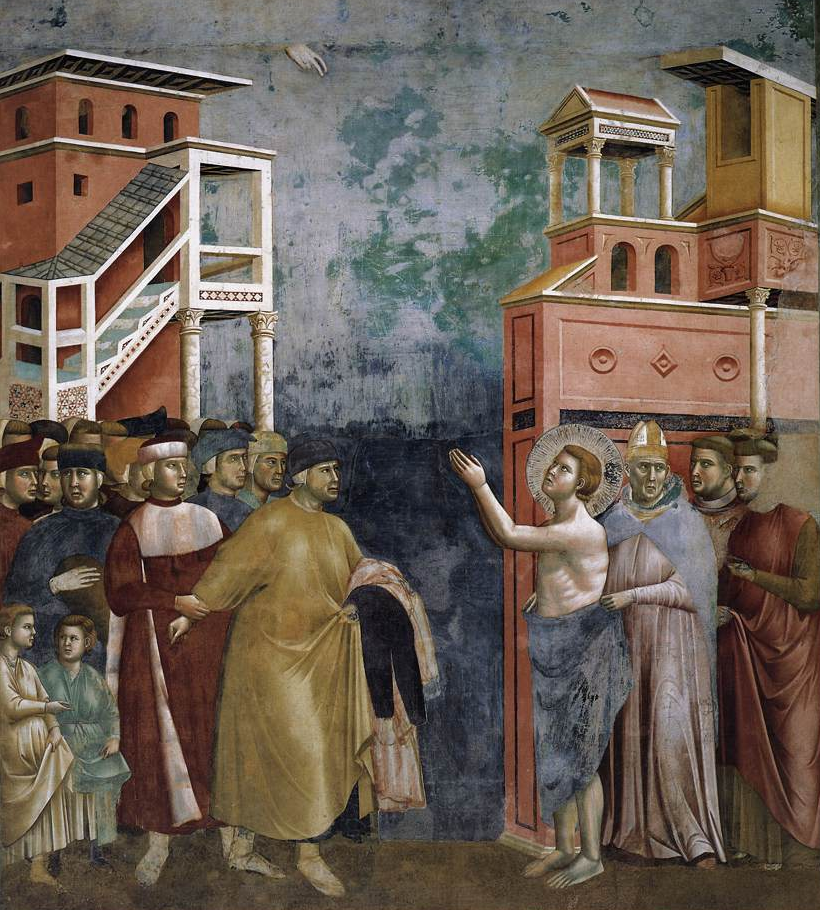
by Giotto di Bondone, 1295
Elphick likewise emphasizes how Francis embraces social reversal in his personal life — transitioning from the wealth into which he was born to poverty, and from the masculinity he was assigned towards femininity — as a way of looking towards the “great reversal of the Gospels.” In other words, because scripture looks towards the day when the “lowly” — including poor people and women — will be lifted up (1 Samuel 2, Luke 1) and there will no longer be “male and female” (Galatians 3:28), Francis emulates that movement in his own life.
In the name Lady Poverty, it is clear that God in the form of these three poor women truly sees Francis and honors all that he is. It is a breathtaking thing to be seen and known in so intimate a way, and Francis is overcome by it:
“At once the saint was filled with unspeakable joy, for he had in himself nothing that he would so gladly have people hail as what these women had chosen.”

I imagine I would have felt that same “unspeakable joy” if God had appeared to me back when I was still going by my birthname and hailed me as Avery, the name I would eventually choose for myself. That ringing rightness as I heard the name that fits me spoken by my Beloved God in greeting would have resounded through my spirit!
Francis has “in himself nothing” that he desires more for other people to “hail” him by — i.e., for them to recognize and call out even upon their first encounter with him. His femininity and his chosen path of poverty are for Francis his two most cherished traits; God sees that and affirms it. Likewise, many trans persons “have in ourselves” nothing that we would so gladly have people hail us by than our chosen names and pronouns.
Thus Mother Francis, Lady Poverty, experienced an affirmation of his gender nonconforming self-descriptors. This section will end with an example of how he used his play with language to welcome a woman into his all-male order.
WELCOMING BROTHER JACOBA AND CLARE OF ASSISI
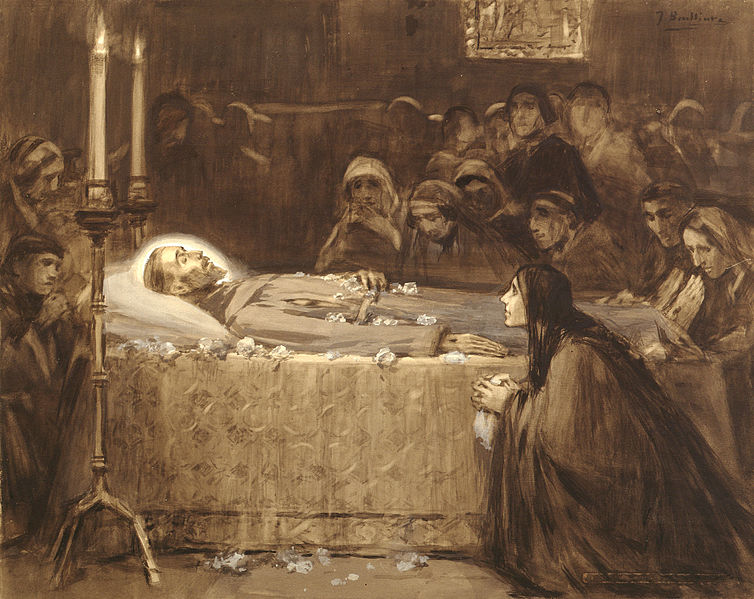
by Josep Benlliure
When a wealthy widow wanted to enter Francis’ cloister, which forbade women’s entrance, Francis used nonconforming language as a tool for bypassing the “all-male” rule, declaring her to be “Brother Jacoba”:
“Blessed be God, who has guided the Lady Jacoba, our brother, to us. Open the door and bring her in, for our Brother Jacoba does not have to observe the decree against women.” For Francis, the feminine and masculine are malleable, and language has the power to shape reality: men like him can be Ladies; women can be Brothers.
(Read More)
Saint Clare of Assisi is another woman welcomed into Francis’ monastery for monks before she went on to start an order of Franciscan sisters. She even received the tonsured haircut and same robes that all Franciscan brothers wore.
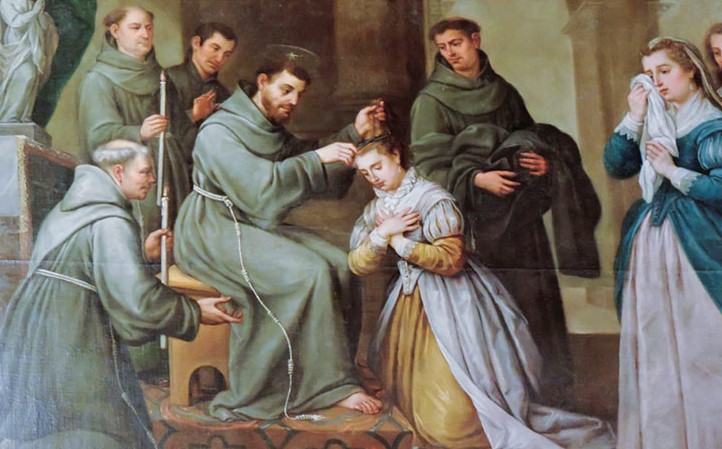
though many feature her about to cut her long hair —
forever frozen in the feminine “before.” This painting
in which her hair is mid-length is the closest I have
found to a depiction of the masculine “after.”
Gender also influenced Francis’s understanding of the created world and humanity’s relationship with it. In his famous “Canticle of the Sun,” Francis greets Brothers Sun, Wind, and Fire; as well as Sister Mother Earth and Sisters Moon, Water, and Bodily Death.
For more on St. Francis’ gender nonconformity as well as on his same-sex lover, see his general article on QSpirit along with the article specifically on his encounter with the all-female Trinity.
THE ANDROGYNOUS CHRIST
The above section on St. Francis noted that he had a vision of the Trinity as all-female; the concept of the divine feminine is one that has existed in Christianity since its earliest days. Indeed, Christian mystics up through the Middle Ages regarded Christ as an androgynous figure, embodying both masculine and feminine traits.
The early Christian community of Syria in particular embraced androgynous images of God, mixing masculine and feminine language when envisioning the Trinity.
(Read More)
See this blog post for examples of Syrian prayers; an excerpt from Ode 8 of the Syrian Odes of Solomon is below, with Christ speaking:
“Love me with affection, ye who love! For I do not turn away my face from them that are mine;
For I know them and before they came into being I took knowledge of them,
and on their faces I set my seal: I fashioned their members:
my own breasts I prepared for them, that they might drink my holy milk and live thereby.”
Saint Anselm’s prayer from c. 1070 is another example of Jesus — as well as Paul the apostle — depicted as a Mother figure:
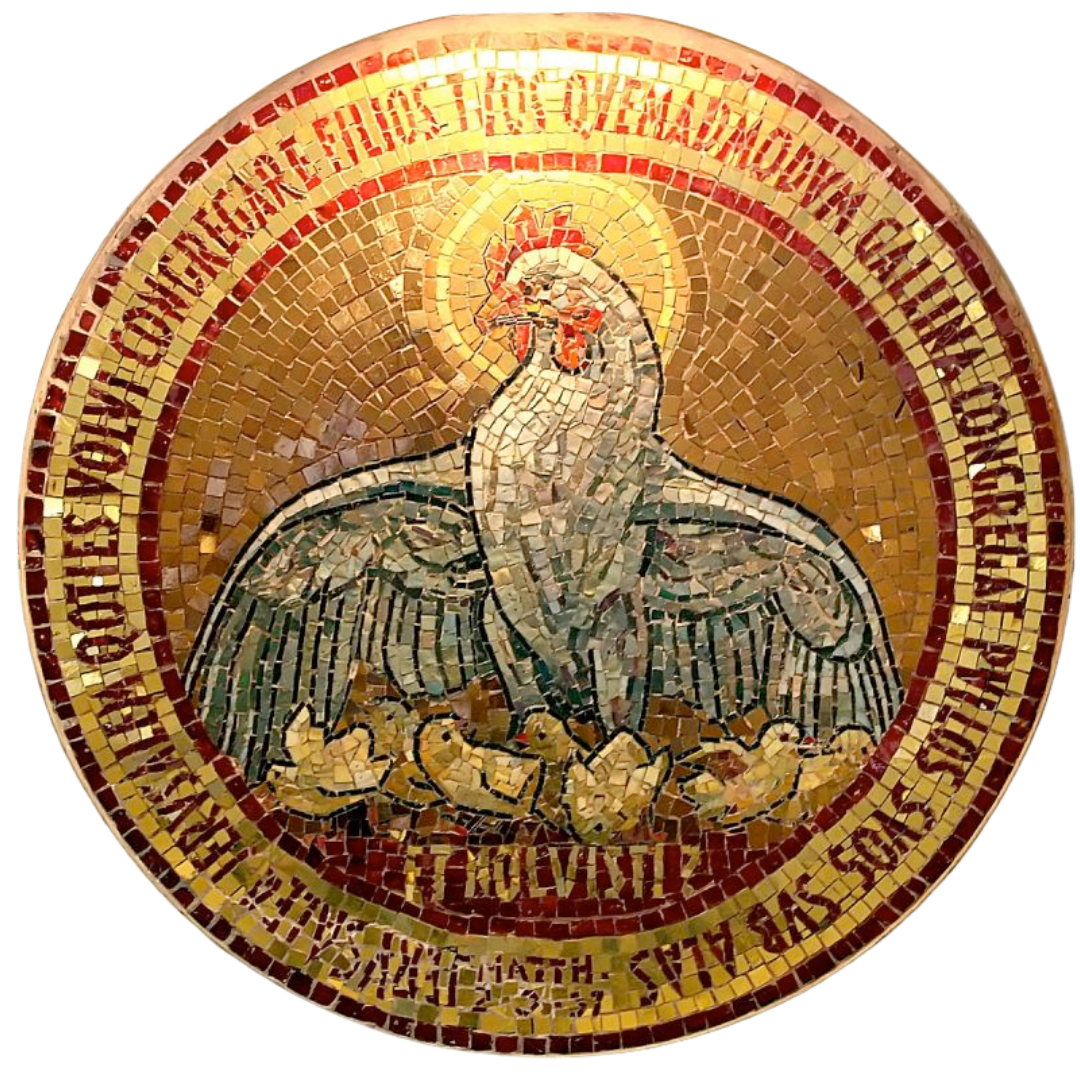
O St Paul, where is he that was called
Saint Anselm29
the nurse of the faithful, caressing his sons?
Who is that affectionate mother who declares everywhere
that she is in labour for her sons?
…
And you, Jesus, are you not also a mother?
Are you not the mother who, like a hen,
gathers her chickens under her wings?
…
For, longing to bear sons into life,
you tasted of death,
and by dying you begot them. …
So you, Lord God, are the great mother.
…
And you, my soul, dead in yourself,
run under the wings of Jesus your mother
and lament your griefs under his feathers.
Ask that your wounds may be healed
and that, comforted, you may live again.
Moreover, from antiquity onward, the wound in Jesus’ side has been analogous to the vulva and vagina. The theology and liturgy of the Orthodox Christian Church takes this image further, envisioning Christ giving birth through this vaginal wound to the Church, much as Eve was brought forth from the side of Adam (16).
Christians who felt they could explore Jesus’s / the Trinity’s gender may have felt liberated to do the same with their own gender identities and expressions. I like to imagine a young mystic learning about the androgynous Christ and thinking “That’s like me! Jesus was like me! I’m okay!”

A BABY BOY AND AN ALLEGED FEMALE POPE
All of the above accounts have shown how gender nonconformity was sometimes allowed and even celebrated among Christians from 100CE through 1399. However, there were also periods during this timespan when gender variance was condemned by the Church; let’s look at one more example of it being permitted, along with an example of how gender variance could be made a mockery of…
(Read more)

Saint Abban was an Irish Catholic abbot of the 400s who was renowned as a “diviner, healer, and magician” (that’s right, because of syncretism, Irish miracle workers were often called magicians!) (17). This abbot was acquainted with an older couple who had been trying for decades to have a child, and finally had a baby girl. While we don’t know the wife’s feelings, I suppose the husband had never heard the phrase “don’t look a gift horse in the mouth,” because he was sad that he still would have no male heir. Enter Abban, who miraculously transformed the baby into a male. Mollenkott notes that this “transsexual miracle proved no bar to [Abban’s] canonization.”30
While Abban’s assistance in transforming a child’s sex did not earn him the disapproval of the Catholic Church, a pope who allegedly gave birth to a child in the 800s was met with dismay.

The historicity of “Pope Joan,” papal name John VIII, is highly contested. If this person existed, Joan only ruled as pope for a few years before dying in childbirth or shortly thereafter. Mollenkott asserts that “the church’s insistence that s/he never existed is symbolic of the religious erasure of transgender experience.”31
On the other hand, if “Pope Joan” never existed, considering why someone would fabricate such a figure reveals something of cultural attitudes surrounding sex and gender. The notion that a woman could “fool” the Vatican into electing her pope would have been supremely embarrassing to the Roman Catholic Church — why? Because medieval theology closely linked womanhood to sin and temptation, a woman pope — especially one whose sexual immorality was on display in the form of a baby — would undermine the sanctity of the position and pose a threat to the entire Church. In our own time, the trope of a trans person’s very existence being a “deception” is similarly used to depict trans people — particularly trans women — as both a laughingstock and a threat to society.
THE GENDERING OF HAIR

In another example of the tension between institutional enforcement of gender norms and everyday folks’ binary-breaking activities, the Church periodically tried to crack down on its men’s hairstyles up through the Middle Ages.
The apostle Paul himself was among the first to impose rules on early Christians’ hair: “Does not the very nature of things teach you that if a man has long hair, it is a disgrace to him, but that if a woman has long hair, it is her glory? For long hair is given to her as a covering” (1 Cor 11:14-15).
(Read More)
Despite the fact that hairstyles’ gendering is culturally contextual, Paul associated his views on hair with what is “natural.” The appeal to “nature” for things that “nature” has no interest in is all too common today as well. Queer folk, our bodies and our sexual and romantic relationships, are attacked as “unnatural” — as if the Christian story were not full of “unnatural” things! There is nothing “natural” about the Resurrection of the dead, to name one key element.
Not long after Paul, Bishop Clement of Alexandria (c. 150-220) bemoaned what he considered the “excessive attention to hair grooming” among some Roman men:
“Oh, these…immoral androgynes and their coifing sessions!”32
Once the Church attained political power as the official religion of the Roman Empire in the 300s, it periodically employed that power to issue sumptuary laws that “condemned the wearing of certain hairstyles, especially those which have been linked to transgenderism, same-sex passion, and luxury or decadence.”33 For instance, in the 1000s there were various demands to stop “all males from entering churches” if their hair was in one of the forbidden fashions. Daring to disobey came with the threat of damnation, for if one could not enter the church one could not receive communion or a proper Christian burial.
Nevertheless, many people seem to have disobeyed: the Church had to reiterate its edict in 1096, in 1102, and in 1103 because “so many men, including members of the clergy, refused to submit.”34

…But why was hair such a threat to the Church, anyway?
Persons assigned female at birth could sometimes get away with cutting their hair in a masculine style; persons assigned male at birth could not get away with a feminine style. Sexism and queerphobia are at play in this double standard: the Church could sometimes allow for a woman “masculinizing” herself, as we saw in above examples like that of St. Perpetua, because it viewed maleness as superior. A woman cutting her hair was a sign of her commitment to virginity and asceticism, a rejection of womanhood and therefore of moral weakness. What the Church could not abide was a man “feminizing” himself.
Those of us who choose to wear our hair in ways that clash with society’s expectations for our assigned gender can look back to the brave persons who defied Church edicts in the Middle Ages for encouragement.
GENDER TRANSGRESSORS: SACRED OR SCAPEGOAT?
So what does all this mean about the treatment of transgender and gender variant persons in Christianity from 100 through 1399 CE? Ultimately, it all depended on context — what any given “gender variant” person was trying to do and what sort of political and social environment they found themselves in.
(Read More)
A person assigned female at birth could be praised for taking on qualities deemed masculine, if the way they did so fit into misogynistic values: Perpetua’s “manliness,” her vision of literally transforming into a man, was praised because of course a woman should aspire to the strength and courage that only men can achieve (please note my sarcastic tone). A woman who grew a beard or disguised herself as a monk to avoid marriage was also lauded, since virginity was so highly regarded.
For Leslie Feinberg, the Church’s decision either to vilify or to canonize a gender nonconforming person all came down to which decision best served the Church’s campaign against pre-feudal religions that threatened its own economic and social power:
”I think the Church fathers may have canonized a constellation of female-to-male trans saints because they were forced to compete with the old religion still popularly embraced by the peasants. The Church hierarchy must have had a tough time trying to convert peasants from their joyous, pro-sexual, cross-gendered religious rites to the gloom and doom of medieval Catholicism. I believe the clerics tried to co-opt popular images of transgender, but with a twist — these female-to-male saints were remarkably pious. Trans images that drew the devotion of peasants to the religion of the owning class would have been valuable in recruitment.”35
Whatever reasons the Church had for accepting some gender variant AFAB Saints, persons assigned male at birth seem to have had even less leeway when it came to expressing themselves in gender nonconforming ways; I know of no canonized transfeminine Saints.
Even so, the transformed capes of the Carmina Burana hint that maybe, sometimes, they had a little wiggle room. In terms of language they used to describe themselves, persons assigned male at birth could refer to themselves as mothers; as well as lovers taking the “passive” and therefore “feminine” role, so long as that language was couched in images of an androgynous God or Christ as bridegroom. Moreover, the Catholic Church actually allowed laypeople assigned male at birth to perform the female roles in their pageants and liturgical dramas,36 giving transfeminine persons one place in the public sphere where they could dress in women’s clothing without condemnation.
We cannot know everything that took place in the seclusion of monasteries and just how many of them provided a sanctuary for people who might nowadays identify as trans. We do know that there were points in Christian history when persons who failed to conform to gender norms were scapegoated and persecuted. Times of epidemic were particularly dangerous for the gender variant: In the 500s, Emperor Justinian accused “effeminate males” of being the cause of earthquakes and plagues. Bernard of Cluny in the 1100s would follow suit, writing: “Even churches are awash in this filthy plague… / … hermaphrodites37 are now very much in fashion!” This homophobia would continue beyond the Middle Ages, as in 1497 Venice when Jimeoto da Lucca preached,
“You close the churches for fear of the plague…This could be avoided if you would eliminate the causes that lead to the plague, which are the horrible sins that are committed [here, including]…the societies of sodomy. Overcome this and you will overcome the plague.”38
Such queerphobia continues into our own day, where “the homosexuals” are blamed for everything from hurricanes to forest fires. The AIDS crisis was a particularly horrific example; called the “gay plague,” the US government allowed HIV/AIDS to bloom into a full pandemic before doing anything about it due to its association with queer folk.
I pray that there will always be monastery-like havens where the gender nonconforming can thrive, where we can gather to combat hatred and celebrate our diversity.

- Transgender Warriors by Leslie Feinberg, pp. 68-71 ↩︎
- From the fourteenth/fifteenth century Compilatio de Sancta Barbara, as translated by Mathilde van Dijk in “Epilogue — Beyond Binaries: A Reflection on the (Trans) Gender(s) of Saints,” Trans and Genderqueer Subjects in Medieval Hagiography (2021), pp. 271-272 ↩︎
- ibid., p. 272 ↩︎
- ibid., p. 276 ↩︎
- Queer Myth, p. 265 ↩︎
- Paula Fredriksen, https://www.pbs.org/wgbh/pages/frontline/shows/religion/why/martyrs.html#perpetua ↩︎
- ibid. ↩︎
- Forgetful of Their Sex: Female Sanctity and Society, ca. 500-1100, by Jane Tibbetts Schulenburg ↩︎
- Jade King, “Saint Wilgefortis: a Bearded Woman with a Queer History,” 2021 ↩︎
- R/B Mertz, Burning Butch (2022) ↩︎
- ibid. ↩︎
- Jade King ↩︎
- ibid. ↩︎
- This piece of art was referenced by a museum curator, though neither they nor the site they source from provide any information about when and where this piece comes from. ↩︎
- ibid. ↩︎
- Omnigender, p. 115 ↩︎
- Queer Myth, p. 107 ↩︎
- Omnigender, p. 114 ↩︎
- Omnigender, p. 115 ↩︎
- Baring-Gould, Sabine (1877). The Lives of the Saints, pp. 70-72 ↩︎
- https://www.oca.org/saints/lives/2019/01/05/100101-saint-apollinaria-of-egypt ↩︎
- Queer Myth, p. 264 ↩︎
- ibid., p. 103 ↩︎
- Queer Myth, p. 88 ↩︎
- Caroline Walker Bynum, Jesus as Mother: Studies in the Spirituality of the High Middle Ages (Berkeley: University of California Press, 1982), 115. ↩︎
- ibid., quoted here: https://agnes.queensu.ca/highlight/unnamed-genderfluid-figure/ ↩︎
- ibid., p. 278 ↩︎
- “Three Poor Women Appeared” by Kevin Elphick, O.F.S., p. 16 ↩︎
- https://aclerkofoxford.blogspot.com/2012/06/anselms-prayer-to-st-paul-our-greatest.html ↩︎
- Omnigender, p. 114 ↩︎
- Omnigender, p. 117 ↩︎
- Queer Myth, p. 167 ↩︎
- ibid., p. 168 ↩︎
- ibid. ↩︎
- Transgender Warriors by Leslie Feinberg, p. 70 ↩︎
- ibid. ↩︎
- Note: this term is considered a slur among intersex people; do not use it in the modern era ↩︎
- Queer Myth, p. 267 ↩︎