
A Framework for Interpreting Scripture
- TWO COMMON FRAMEWORKS FOR READING SCRIPTURE
- MUST WE TAKE SCRIPTURE "LITERALLY" TO TAKE IT SERIOUSLY?IS IT HUMAN OR DIVINE?
- ARGUMENT FOR A NON-LITERAL APPROACH TO THE BIBLE
- WHEN HUMAN PERSPECTIVES MASK GOD’S TRUTH
- HOW DO WE DISCERN WHICH PARTS OF SCRIPTURE ARE HUMAN AND WHICH DIVINE?
- ACKNOWLEDGING OUR BIASES
- "YOU'RE JUST READING INTO IT"
- FURTHER READING
If you have only ever been taught one way to interpret scripture and/or one way to understand the concept of “Divine Inspiration,” it may surprise you to know that not all Christians understand these concepts in the same way! For instance, must we take the Bible “literally,” or might some of it be figurative? Must every event described in the Bible have happened exactly as recorded? And must the Bible be a word-for-word message from God in order to be divinely inspired, or might we perceive God as working through human authors in order to speak to us through scripture?
The goal of this page is not to convince anyone to read the Bible the same exact way that I do, but to help get you thinking about your own framework!
Many of us don’t stop to consider what assumptions, biases, and baggage we bring to our biblical interpretation. But when we take the time to unpack these things — and to take stock of what we do and don’t know about biblical contexts, and figure out what we want to learn more about — we can build a healthier, more fruitful relationship with scripture. My hope is that this webpage can provide you with building blocks for your biblical framework.
TWO COMMON FRAMEWORKS FOR READING SCRIPTURE
The bullet points below compares biblically “conservative” and biblically “liberal” beliefs surrounding Divine Inspiration and authority. It is important to note that any attempt to simplify these complex beliefs will never be perfectly accurate, and that many Christians’ beliefs around these topics reflect a mixture of “conservative” and “liberal” viewpoints (or even something different altogether).
Also important to note is that “conservative” and “liberal” don’t mean quite the same thing in theology that they do when we’re talking politics. A conservative framework emphasizes tradition, “conserving” doctrine; while a liberal framework reevaluates doctrine and “the way things have always been done,” with the goal of making theology and scripture more applicable to contemporary contexts.
Conservative Viewpoints
- The Bible is the inspired word of God and contains sufficient and exclusive truth for salvation
- The Bible gives a fully factual account of events as recorded, “and passages have a meaning that is universally true and clearly evident to those who have faith”1
- The Bible doesn’t need to be “interpreted,” as its meaning is evident. Context and archeological / sociological perspectives are thus unnecessary
- Examples of beliefs that stem from reading scripture literally: rejection of divorce, abortion, premarital sex, queerness; “a rejection of other religions as means of access to God or to salvation.”2
Liberal Viewpoints
- The Bible is inspired truth about God and is not necessarily authoritative on all matters
- The Bible contains a mixture of literal and symbolic truth; contains human errors as God’s inspiration comes through the writing of human authors
- “What the bible means may depend on who is reading it“1 — We don’t read scripture in a vacuum; we bring our assumptions, values, traumas, knowledge, etc. with us to the text
- Context matters! What was happening socially and politically when the text was written? What were the literary goals of the text’s author/s and editor/s? How has this passage been used over the years?
MUST WE TAKE SCRIPTURE “LITERALLY” TO TAKE IT SERIOUSLY?
IS IT HUMAN OR DIVINE?
Some Christians profess the Word of God to be perfect, truth itself. But what is the Word of God? Is it a collection of texts gathered into a canon and named the Bible (and if so, which canon)? Is the Word of God a physical object you can hold in your hands?
The opening of the Gospel of John reminds us what the Word is: it’s Jesus, God’s Word incarnate!
“Do you believe in the Bible? Strictly speaking, Christians whose faith is in God’s self-revelation have to say No – precisely when we take the Bible seriously. Our faith is not in the book but in the God we learn to know in it.”
Shirley Guthrie, Christian Doctrine
It’s possible to make the Bible into an idol, in which we worship it instead of the God it reveals to us. For while the Bible is a vital instrument for learning about God and God’s will for us, it is in the end “only” an instrument, “only” a collection of texts – not God in itself.
(Read more)
The Bible is the millennia-long story of God’s liberating activity in our world – but we view this story through a human lens. And humans are flawed – especially when the humans in question are (mostly) men living in a patriarchal society surrounded by conquest-loving nations. The texts of the Bible do not claim to be God’s verbatim messages (though some, such as the books of the prophets, do claim to quote God’s messages); they have human authors. And human beings are biased; we all see the world differently, colored by our social location, personal experiences, and so on.
Throw in the fact that writing techniques, processes, and preservation were totally different then from now, and one realizes how important it is to take a non-literal view of scripture in order to glean the divine Truth carried in a vessel of human words.
ARGUMENT FOR A NON-LITERAL APPROACH TO THE BIBLE
Some Christians believe that because the Bible carries God’s Truth, every single word of it has to be true – or rather, convey completely factual events, as well as ideas that coincide with God’s own thinking. However, if you sit down and start reading a well-annotated copy of the Bible, it’s likely you’ll soon notice that there is plenty in scripture that is not factual – contradictions, anachronisms, literary motifs, symbolism, and hyperbole abound, as do ideas that just don’t line up with what Jesus teaches us about a God of Love. So, if there are things in the Bible that aren’t quite factual…is it all still True?
(Read more)
The reading guide of the Catholic Study Bible discusses this issue. In one section, it explains why some Christians feel the need for a literal reading:
“Some Christians, particularly fundamentalist Christians, fear that admitting the Bible contains poetry, stories, and other literary forms is somehow an attack on the veracity of the Bible and dilutes its witness to history. They prefer to regard the story of creation in Genesis, or the episode of Jonah’s sojourn in the belly of a great fish, as literally [fact]” (p.5).
In a later section, the reading guide discusses why it’s okay (and makes sense from a scholarly, historically contextualized perspective) to take a non-literal reading of the Bible, explaining how the human writers of the Bible were not primarily historians, even when recounting the past:
“The biblical writers drew upon tales and traditions of Israel’s past in order to communicate an idea to their contemporaries. They were not concerned about whether the tales and traditions were reliable or plausible. Even when some attempt was made to communicate factual information, such as in the books of Kings, the writing of history was secondary to other purposes of the biblical writers” (p.30).
So what does all this mean for us as readers of the Bible?
For one thing, it frees us to approach scripture without certain expectations, and allows us to bring our doubts to the table with us. We don’t need to be afraid of our own thoughts while reading the Bible! If something in the text seems questionable, we don’t need to run from our questions: we can embrace them, and seek the Spirit’s guidance as we strive to analyze God’s Truth hiding behind what may or may not be “fact.”
Some of the non-factual facets of scripture that you can keep an eye out for while reading are discussed below, from basic anachronisms to intentional literary devices. Lastly and most importantly of all, how the Jewish (or, in a few cases, early Christian) viewpoints of the writers color a biblical text and why acknowledging these human authors’ biases matters will be explored.
- Borrowed Stories: In the case of the earliest chapters of Genesis in particular, scholars have identified stories that were borrowed (but altered) from those of the ancient Israelites’ neighboring nations, including that of Creation and that of the Flood. See this post I made some time ago for a detailed explanation of this interesting topic.
- Anachronisms: Sometimes a biblical text will make mention of an event or feature that existed in the author’s own time but not in the time of which they were writing. For example, in 1 Samuel 17:54, David is said to return to his tent in Jerusalem after slaying Goliath – but Jerusalem did not “belong” to the Israelites until some time later in David’s story, when he conquers it as a king.
- Contradictions: Biblical books often contradict themselves or one another. One example involves the age of Ishmael – in one chapter (Gn 16:16), Ishamael is said to be at least 14 when his half-brother Isaac is born; in another (Gn 21:14), he is but a young boy. That the Torah/Pentateuch as we have it today is constructed from multiple authors largely accounts for this discrepancy (see this link to learn about the documentary hypothesis, which describes how four strands of tradition were edited together to form the first five books of the Bible).
See this webpage for many more contradictions found within the Bible (disclaimer: some of the things that webpage cites as contradictions can be read in other ways; use your own judgement).
- Literary Motifs and Patterns: as discussed above, the writers of the Bible were not usually primarily interested in recording history. Instead, they used accounts of their people’s past to paint an image of God and God’s active role in their timeline as they saw it. Thus, countless motifs can be found.
A well-known example is the motif of the barren mother who gives birth to an important person – think of Isaac, Joseph, Samuel, and John the Baptist. Whether or not these people were “really” were born of previously infertile mothers is not as important as the message the motif serves to convey: that God had a direct hand in the conception of these people, thus marking them as important in God’s plan.
Find descriptions of many biblical motifs here (or, believe it or not, see them on sparknotes).
“When God gave us the Bible, God did not give us an internally consistent book of answers. God gave us an inspired library of diverse writings, rooted in a variety of contexts, that have stood the test of time, precisely because, together, they avoid simplistic solutions to complex problems. It’s almost as though God trusts us to approach them with wisdom, to use discernment as we read and interpret, and to remain open to other points of view. ‘The iconic idea of the Bible as a book of black-and-white answers,’ wrote Beal, ‘encourages us to remain in a state of perpetual spiritual immaturity. …In turning readers away from the struggle, from wrestling with the rich complexity of biblical literature and its history, in which there are no easy answers, it perpetuates an adolescent faith. It keeps us out of the deep end, where we have to ‘ride these monsters down,’ as Annie Dillard put it, trusting that it’s not about the end product but the process.’”
Rachel Held Evans, Inspired: Slaying Giants, Walking on Water, and Loving the Bible Again
- Narratives Masquerading as History: It might surprise you to learn that some books of the Bible were never intended to be viewed as anything but fiction! These include Jonah, Job, and (for Catholics/Orthodox Christians) Tobit, which all fall into the category of narrative. (Jesus’s parables count as well, but most Christians easily recognize those as fiction.) While nowadays writing tends to make its genre clear (a novel will tell you it’s a novel, etc.), in the days of biblical writers it was perfectly normal to tell a story without explicitly mentioning that, oh right, you made it some or all of it up. However, you would leave clues that you’d expect your audience to pick up on.
For one example, Jonah is clearly meant to be fictional for several reasons: 1) Jonah is an antiprophet, who behaves in ways the “real” prophets of the Bible do not (such as running away when God calls him and being upset when his mission actually succeeds); 2) the whole fish thing is intended to be humorous; and 3) the original Jewish audience would have recognized that the city that Jonah convinces to repent of its wickedness, Nineveh, never actually repented – it was the capital of Assyria, whom the Jews of the period despised. Assyria had oppressed the Jewish people for years, and the author’s purpose in picking them for his story is to highlight just how incredible God’s mercy is, forcing its audience to reconsider their stereotypes and realize that God cares for evil Assyrians as much as for Israelites.
WHEN HUMAN PERSPECTIVES MASK GOD’S TRUTH
“The LORD does not see things the way you see them. People judge by outward appearance, but the LORD looks at the heart” (1 Samuel 16:7)
(Read more)
This webpage offers a concise explanation of how the Bible’s messages come from both divine and human sources:
“God never uses people as robots; thus, when God inspired them to write the books of the Bible, God inspired them as people with different outlooks, skills and abilities. This helps to explain the differences in the books of the Bible, sometimes within a particular book itself.
Sometimes the inspired word of God is poorly written Hebrew or Greek because God inspired authors who wrote Hebrew or Greek poorly. If God had dictated God’s message, the inspired word would not have been poorly written.”
Knowing that the perspectives of human writers color the Bible’s messages, it becomes evident that we need to learn a bit about where these writers were coming from, as their cultures – their understanding of the nature of the universe, what they expected from literature, and their relations with genders, customs, and nations beyond their own – can differ vastly from ours.
This all leads to the vital question:
HOW DO WE DISCERN WHICH PARTS OF SCRIPTURE ARE HUMAN AND WHICH DIVINE?
I do not believe that we can ever be so audacious as to claim we know for sure what God wants. We are so small, and God is infinitely vast; our ways are not God’s ways (Isaiah 55:8-9). But God offers us glimpses of Herself, reveals aspects of Herself through scripture, and so we can with humility try our best to determine God’s movement in any passage of scripture. Some of the methods we can apply to this endeavor are explored in the below section titled “Being aware of our biases when reading the Bible.”
(Read more)
That we might be headed in the wrong direction can be a scary thing — but we can take comfort in our God’s compassion. The best we can do when seeking what the Bible teaches us about God’s will is to reflect, pray, research, encounter, experience, discuss, and make the most faithful interpretative decision we can.
One of Thomas Merton’s most famous prayers can serve as a prayer for grace when we get things wrong, promising us that if we proceed in our biblical interpretation prayerfully and thoughtfully, we can rely on the mercy of our loving God to cover any misinterpretations we make.
“…the fact that I think I am following your will
does not mean that I am actually doing so.
But I believe that the desire to please you
does in fact please you.
And I hope I have that desire in all that I am doing.
I hope that I will never do anything apart from that desire.And I know that if I do this you will lead me by the right road,
though I may know nothing about it.”– Thomas Merton
“The difficulty of faithful biblical interpretation lies not just with us; it lies in the Bible itself. It is not one book but a collection of writings composed by and for ancient Near Eastern people over a long period of time. It bears witness not to general, timeless truths about God, but to the way different people and groups, using different ways of speaking and thought forms, discerned the word and work of God in their particular time, place, and situation. All of them lived with a prescientific, preindustrial worldview, in a patriarchal-hierarchical society that generally treated women as inferior, accepted slavery as normal, and did not even dream of all the complex problems and needs of the kind of modern technological society we live in.
Shirley Guthrie, Christian Doctrine
How are we to discern in this ancient book what the living God is saying and doing in our quite different time and place? How are we to distinguish within scripture what is the will of God in all times and places from what was God’s specific will for particular people in one or another of the particular historical situations in the Bible?”
In Gay Theology without Apology, Gary David Comstock notes that many put the Bible in something of a parental role — the kind of parent who requires unquestioning obedience. He suggests a different, more equal kind of relationship:
“Instead of making the Bible into a parental authority, I have begun to engage it as I would a friend — as one to whom I have made a commitment and in whom I have invested dearly, but with whom I insist on a mutual exchange of critique, encouragement, support, and challenge. Such investment and commitment hinge on deeply felt and shared experience, meaning, and outlook — a cooperative project to live fully that both changes and remains steady through joys and sorrow.”
ACKNOWLEDGING OUR BIASES
“The truth is, you can bend Scripture to say just about anything you want it to say. You can bend it until it breaks. For those who count the Bible as sacred, interpretation is not a matter of whether to pick and choose, but how to pick and choose. We’re all selective. We all wrestle with how to interpret and apply the Bible in our lives. We all go to the text looking for something, and we all have a tendency to find it.”
Rachel Held Evans, Inspired: Slaying Giants, Walking on Water, and Loving the Bible Again
One argument made against LGBTQ+ Christians who find affirmation in scripture is that we are simply “justifying our sin.” And while I firmly disagree, the people who argue this bring up a point that all of us need to be aware of: we all do bring our biases, our preconceived notions of right and wrong, into our study of scripture. Everybody “cherry picks” the bits of scripture we like, while rejecting what we don’t like. It’s better to acknowledge that we do this, rather than lying to ourselves about our subjectivity.
People on all sides of the LGBTQ “debate” (or any debate, for that matter) can easily go to the Bible seeking not God’s truth but merely confirmation of their own side:
”There is always the danger that we will find in the Bible only what we take with us to it – that we will use it to confirm what we already think and will only hear what we want to hear. …Comfortable, powerful people usually find that the Bible supports social and political conservatism; poor, exploited people usually find that it supports social and political reform or revolution. What is to keep us from simply using the Bible to give authority to our own religious, social, political, and economic prejudices? What is to prevent us from using the study of this ancient book as a pious excuse for refusing to face the radical claims of the living God on every area of our lives, here and now?”
– Shirley Guthrie, Christian Doctrine
(Read more)
So what do we do about this human tendency towards confirmation bias? How do we read the Bible without misusing it for our own ends?
The chapter “Who Is a Theologian?” of Shirley Guthrie’s Christian Doctrine lays out advice for how to read the Bible “rightly” rather than using it just as confirmation of our own biases. The following bullet points regarding how to minimize our biases and make a faithful interpretation are based largely on what Guthrie says in that chapter.
- Patient and prayerful reflection, as well as research, are necessary to reading the Bible “rightly”. We should not isolate ourselves when studying scripture, as if we were the first person to ask a certain question of it; rather, we should pray for the Spirit’s guidance and study the interpretations of faithful Christians (note that it is all right to question any Christian’s interpretations, even the famous and celebrated ones! Just don’t immediately discount them without giving them thought first).
- Recognize that scripture should be interpreted in the light of its own purpose – that purpose being to teach us who God is and how we may live faithfully. The Bible is not meant to be read like a science or history textbook.
- Take things like the humanity of the biblical writers and context into account while reading. “Context” includes the literary, historical, and cultural context of the peoples who wrote the Bible as well as our own cultural context and what we bring from it into our reading.
- Recognize that single verses or passages on an issue are rarely the Bible’s only message about that issue (it is a big book, after all, and written by multiple people). When looking at one passage that seems to speak for or against your viewpoint, make sure to consider other passages related to the issue that offer a fuller understanding of the broader biblical message as well.
- View all aspects of scripture through the lens of Jesus’s ministry as recorded in the Gospels – seeing Jesus as the clearest revelation of who God is and what God wills is termed the “christological principle.” When there are biblical passages that seem to conflict with each other, the “final say” should go to what Jesus’s words and actions seem to point to.
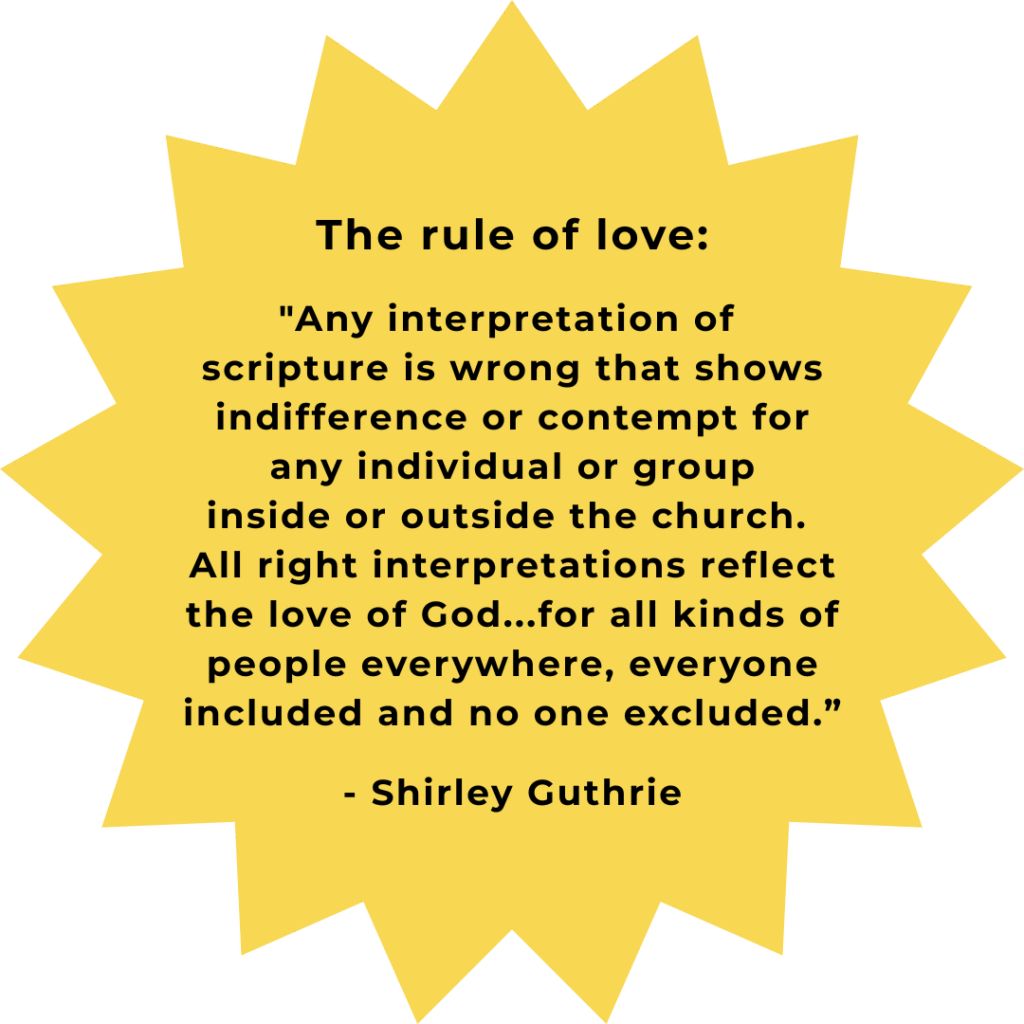
- Follow the “rule of love” – an interpretation should agree with the fact that “the fundamental expression of God’s will is the twofold commandment to love God and neighbor. If your biblical interpretation causes harm to any living being (including yourself!), it is not of God.
All of us should work towards engaging with scripture in a prayerful manner that seeks not to confirm our own views but God’s truth – even while recognizing that the perspectives we bring based on our own experiences and cultural context will be the lens through which we view scripture, and that’s okay. Finding a balance is what is key.
“YOU’RE JUST READING INTO IT”
When LGBT+ Christians choose to accept the affirmation the Bible offers rather than viewing scripture as condemnatory, a common phrase they have to face from some other Christians is “you’re just seeing what you want to see.” Well, I will concede one point there. When I first realized I was queer, I did want to see affirmation in the Bible, with a desperation that many straight, cisgender people cannot possibly understand. I wanted, needed, to find love and acceptance in the book that tells the story of my making, my salvation – my entire being ached for it. And, praise God, I found it.
(Read more)
Despite the insistence of today’s popular scriptural interpretations, despite the fears that maybe I was just “reading what I wanted into things,” despite rejection and doubts and pressure from mainstream Christianity…I found my peace. I found the love and acceptance I was seeking in the Word of my Maker. I found life.
“You’re projecting your own biases onto the Bible. You say it doesn’t condemn queerness because you don’t want it to.” Hmm. I’ll put aside the obvious but not often effective rebuttal – maybe you’re reading condemnation into scripture merely because you’ve been raised to! – and ask a question instead: You know how people often say that God makes everything happen for a reason? Well, perhaps God made me queer for a reason: so that I would read Hir Word differently. So that I would have a reason to move beyond popular interpretations that harm so many people, deny so many identities, suffocate so many lives.
Because I’m queer, I’ve been able to break past the traditional interpretations that many other Christians have been conditioned to simply accept. Because I’m queer, I’ve had to wrestle with scripture, to ponder it and ask questions of it in a way that some straight, cis Christians may never have to. And just maybe, the faith that has resulted from all this self-examination, all these hours hunched over the Bible desperately seeking hope, is imbued with something unique, something new, something that can stir up fresh meaning and illuminate truths and joys that once were hidden within Christ’s Body.
So yes, maybe I am just “reading into things.”
But maybe that’s exactly what God was hoping I would do. I choose to see God’s Word as life-giving, as all-embracing, as both eternal and eternally new. Maybe being made queer has helped me to do that. How about you?
“James Does Not Belong to You”
Avery Arden, published in
The Kin-dom in the Rubble
you tell me King James’ Bible
is the one true Bible, and that
it condemns me unequivocally.
but what do you know of King James?
do you know he was like me?
do you know he had a passageway to link
his chamber to his lover’s? do you know
he said “David had his Jonathon, and i
have my George” –
do you know, do you even know
that David was like me?
that Jonathon was like me?
and do you know, do you understand that you can never stomp out,
you can never ever quell
what is queer in the Body of Christ
for that queerness sings from every page
of that book you and i
both call good
and pumps through the blood of so many breathing bodies
that i and our God call Good
and where you point at dry pages and see
only dry bones for me
God points and says look! these bones shall live!
so – in spite of all
you throw at me —
i live.
FURTHER READING
- “Are you taking the Bible Seriousy?” – A short video by Austen Hartke on interpreting scripture with reverence while taking context into consideration
- A Guide to Bible Basics by Tyler Mayfield